Airbus launched the A320neo to end the CSeries. The unit that ran the campaign also ran the largest corporate bribery scheme in European history. The bribery inflated the order book. The order book consumed the engine supply. Bombardier delivered seven aircraft instead of fifteen, sold the programme for nothing, and left commercial aviation.
In late 2007, Bombardier selected the Pratt & Whitney PW1500G geared turbofan as the sole engine for a clean-sheet narrowbody called the CSeries.1 CFM and IAE had both declined to bid.2 That decision gave Bombardier a technological lead and a structural vulnerability: one engine, one supplier, no alternative.
Three years later, Airbus bolted the same engine family onto the A320 and launched a programme designed to make the CSeries commercially unviable.3 The unit that ran that campaign also managed, in the same years, a bribery apparatus spanning twenty countries and more than a billion dollars in intermediary payments.4 The SFO, the PNF, and the DOJ treated these as separate matters. The organisational chart says they were not.
I. The war was declared in public
On February 25, 2010, Republic Airways ordered 40 Bombardier CS300s with options for 40 more.5 Republic owned Frontier Airlines, an exclusive A319/A320 operator. An Airbus customer had defected.
John Leahy, Airbus’s Chief Operating Officer for Customers, responded at the company’s annual media day. Airbus was “declaring war” on the CSeries.6 Leahy said he would not allow Bombardier to establish a “beachhead.” He would not repeat Boeing’s error of ignoring a competitor and allowing it to grow.6
On November 30, 2010, the EADS board approved the A320neo.7 Tom Enders was “the last to sign on."8 On December 1, the programme was announced with two engine options: the CFM LEAP-1A and the Pratt & Whitney PW1100G-JM, a variant of the same PW1000G geared turbofan family that powered the CSeries.9
Leahy’s assessment: “The launch of the NEO kills the business case for Bombardier’s CSeries."10
In head-to-head campaigns, Airbus dropped A320 pricing and offered airlines “a larger airplane for the same price as the CS300."6 The A319neo variant competed directly with the CS300 in the 120-to-160-seat range. Total A319neo orders as of late 2025: 57, half a percent of the A320neo family’s 11,605.11 The A319neo was a spoiler, not a product.
Leahy, reflecting in October 2017: “We were competing against it for years, rather successfully."6
II. The order wave
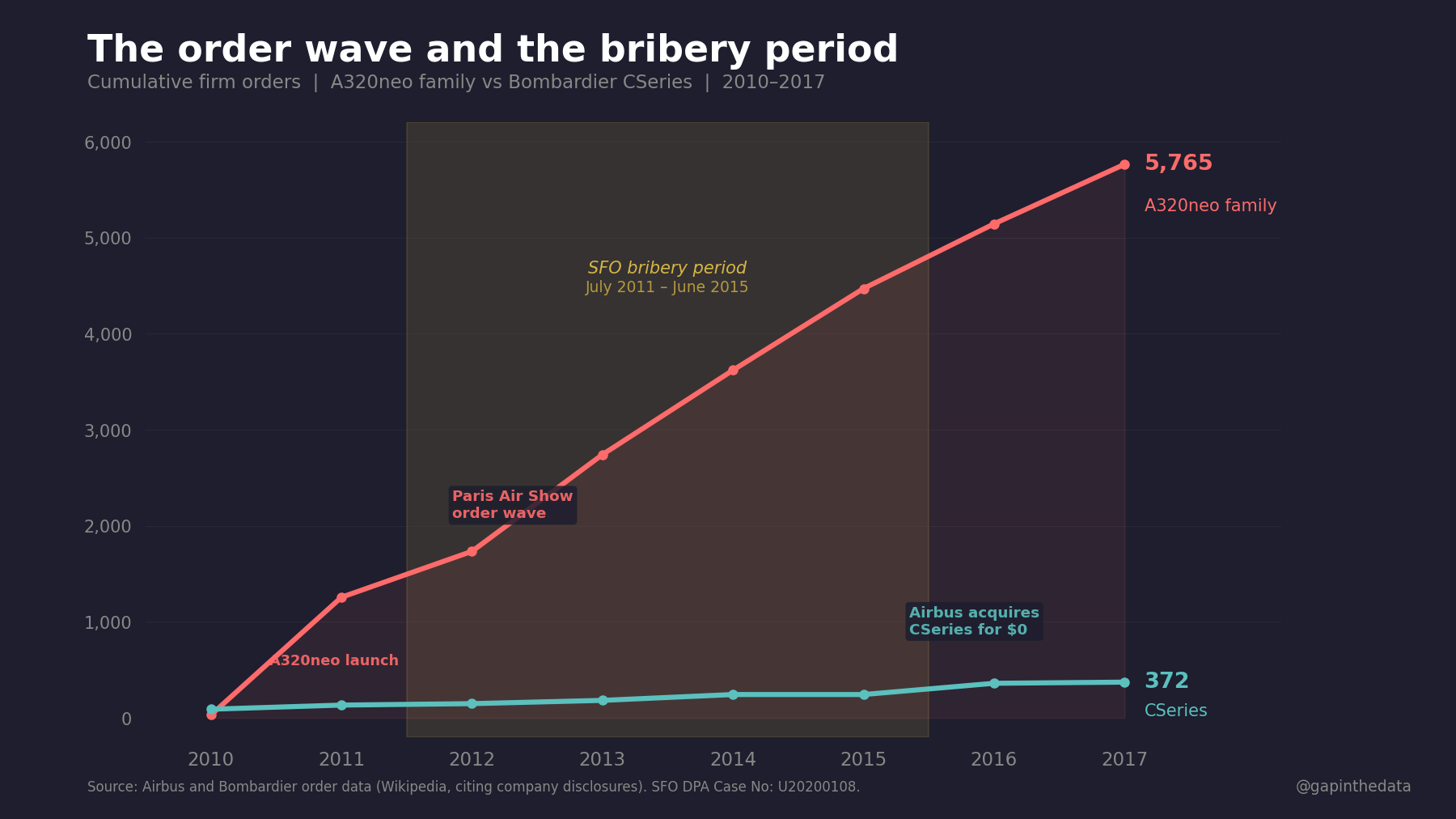
The A320neo accumulated orders faster than any commercial aircraft in history. At the Paris Air Show in June 2011, 667 commitments worth $60.9 billion were announced in a single week.12 AirAsia ordered 200 A320neos on June 23.13 IndiGo confirmed 150 on June 22.14 American Airlines ordered 130 A320neos and 130 A320ceos on July 20, the first time in decades that an all-Boeing carrier had ordered from Airbus.15
By year-end 2011, the A320neo family had 1,256 firm orders. The CSeries had 133.11 16
| Year-end | A320neo family | CSeries | Ratio |
|---|---|---|---|
| 2010 | 30 | 90 | 0.3:1 |
| 2011 | 1,256 | 133 | 9.4:1 |
| 2012 | 1,734 | 148 | 11.7:1 |
| 2015 | ~4,500 | 243 | ~18.5:1 |
After 2011, the ratio never dropped below nine to one. Both programmes drew engines from the same Pratt & Whitney geared turbofan family.
III. The shared engine
The CSeries ran on the PW1500G. The A320neo offered the PW1100G-JM as one of two engine options, the other being the CFM LEAP-1A. The PW1100G and PW1500G share core architecture and common tier-one suppliers including MTU Aero Engines.17 They competed for the same manufacturing capacity, the same engineering attention, the same supply chain.
Airbus had two engine suppliers and could shift customers to LEAP when Pratt & Whitney fell behind. Bombardier had one.
In 2016, P&W planned approximately 200 GTF deliveries. Fan blade inspection pass rates of only 75% forced a revision to 150.17 Bombardier delivered seven CSeries against a target of fifteen.18 In 2017, P&W targeted 350 to 400 engines and delivered 374.17 Bombardier revised its delivery target from 30-35 to 20-22, then achieved 17, citing “persistent engine delivery delays."18 In the same period, more than 40 completed A320neo airframes sat on Airbus ramps waiting for PW1100G engines.19 Airbus could route customers to the LEAP. Bombardier could route customers to nothing.
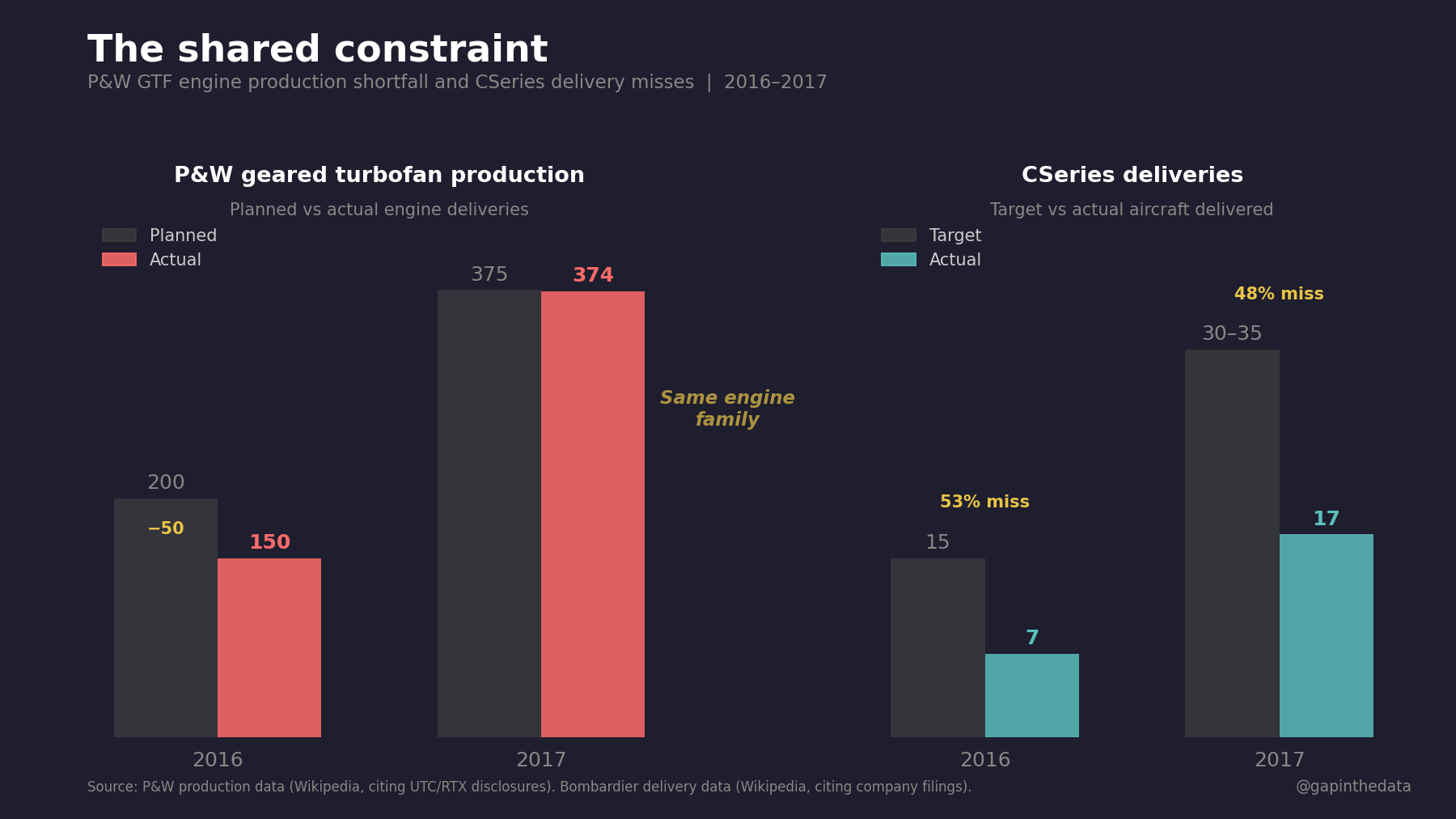
At half its backlog on PW engines, the A320neo programme demanded more than ten times as many PW1000G-family engines as the entire CSeries. When production fell short, the allocation was determined by commercial gravity.
IV. What the bribery unit was doing
The Strategy and Marketing Organisation was Airbus’s competitive strategy unit. Marwan Lahoud held the title of Chief Strategy and Marketing Officer from 2007.20 The SMO managed business partner relationships across more than twenty countries through approximately 150 employees with an initial annual budget of $300 million.4 Within it, a sub-unit called International Operations, approximately 15 people, was described by a former Airbus executive as “like our secret service, whose job was to handle the dirty tricks."21 Tom Enders dissolved the SMO in 2016. He called it “the bullshit castle."21
The SFO’s five counts of failure to prevent bribery cover July 1, 2011 to June 1, 2015.22 The same period in which the A320neo accumulated the order wave that overwhelmed P&W’s production capacity.
Count 1, Malaysia. Airbus paid €50 million to sponsor the Caterham F1 racing team, owned by AirAsia CEO Tony Fernandes and chairman Kamarudin Meranun, and offered an additional €55 million, in connection with 180 aircraft orders.22 23 AirAsia’s 200 A320neo orders at the 2011 Paris Air Show were among the largest single commitments of the period.13
Count 3, Taiwan. Airbus channelled $14.34 million through intermediaries to secure 20 aircraft purchases from TransAsia Airways. An intermediary was nicknamed “Fu Fu,” a bribe recipient called “Van Gogh,” and an Airbus official referred to as “Dr. Brown” who “prescribed medication and dosages."22 24
Count 4, Indonesia. Airbus paid over $3.3 million to employees or family members of Garuda Indonesia and subsidiary Citilink to secure purchases of 55 or more aircraft, including A320s.22 25 CEO Emirsyah Satar received 13 years across two convictions.25
The French PNF’s settlement covered bribery in sixteen additional countries.4 In Colombia, a bribe was agreed ahead of Avianca’s order for 100 A320neo aircraft in April 2015. The bribe was never paid because Airbus froze the intermediary’s payments in 2014.26 The order proceeded. In China, between 2013 and 2015, Airbus paid bribes to government officials at state-controlled airlines through a “monetary fund” used for “golf retreats and leisure events."27
V. The organisational fact
The bribery-linked A320-family orders traceable in public settlement documents total at least 355 aircraft: 180 from AirAsia, 100 from Avianca, 55 or more from Garuda/Citilink, and 20 from TransAsia.22 26 Against the A320neo family’s 11,605 total orders, that is 3%. Against P&W’s production shortfall of roughly 50 engines in 2016, the marginal impact of even a fraction reaching the production queue would have been significant. Engine ramp-ups fail at the margins.
No litigation or regulatory proceeding has connected the bribery to the CSeries’s demise. We cannot prove that P&W would have had capacity for more PW1500G engines absent the bribery-linked orders.
What we can establish is the organisational fact: the same unit managed both the bribery pipeline and the competitive strategy against the CSeries. The bribery inflated the A320neo order book. The order book consumed the engine capacity that the CSeries needed to survive. These were concurrent activities by the same people, under the same budget, toward the same objective.
VI. What Bombardier brought on itself
Bombardier’s failures compounded the damage. Development costs tripled from $2.1 billion to $7 billion.28 18 The programme ran three years late.18 An uncontained engine failure in May 2014 suspended flight testing.18 Bombardier’s own market studies concluded that re-engining the A320 “made no economic sense and was unlikely to happen."2 Leeham News called this “incredibly naive,” noting it had predicted the A320neo launch eighteen months in advance.2 By October 2015, the company was burning $800 million per quarter and was, by its CEO’s later admission, “on the brink of bankruptcy."2 29
Boeing’s 292% tariff on the Delta CS100 order was the final blow.18 On October 16, 2017, Bombardier handed 50.01% of the programme to Airbus for no cash. In January 2018, the ITC voted 4-0 to overturn the duties, finding Boeing did not make a competing aircraft.18 In February 2020, Bombardier sold its remaining 34% for $591 million and exited commercial aviation.18 A $7 billion programme, for $591 million, after the majority stake had already left for nothing.
VII. The constraint that survived the acquisition
Airbus renamed it the A220, opened a second assembly line in Mobile, Alabama, and applied its procurement scale. Orders increased, briefly. JetBlue ordered 60 A220-300s in 2018.16
Then the same engine arrived for Airbus.
The A220 production rate target was 14 per month. It has been reduced to 12, with a partial recovery to 13 targeted by 2028.31 Roughly 22% of the global A220 fleet is grounded for PW1500G powder metal inspections, with turnaround times stretching to 300 days.32 Airbus took a €500 million impairment on the A220 in FY2025.33 The CEO declined to provide a breakeven date.31
The A220 had zero new orders in 2025, the worst year in the programme’s history.34 Embraer took 154 E-Jet E2 orders in the same period.35 Finnair ordered Embraers because Airbus had no delivery slots before 2032.35
The bottleneck that killed Bombardier was never Bombardier. The PW1500G was undersupplied in 2016 because of a production ramp overwhelmed by A320neo demand. The PW1500G is undersupplied in 2026 because of metallurgical defects and a fleet too large to inspect in time. The cause changed. The constraint did not. Airbus bought a programme with a single-source engine dependency for nothing, and eight years later, that dependency defines the programme.
VIII. What the duopoly absorbed
The CSeries was the last market-funded attempt to break the Airbus-Boeing narrowbody duopoly from within the Western certification system. Bombardier designed a clean-sheet aircraft with next-generation engines, certified it with three regulators, and put it into commercial service. Swiss and airBaltic operated it. Delta ordered 75. It worked as an aeroplane.
The programme failed as a business because its sole engine supplier could not deliver engines fast enough, because its manufacturer could not sustain the cash burn, and because its primary competitor launched a programme explicitly designed to ensure it would fail. That competitor’s sales chief said so publicly, and the unit that executed the competitive strategy simultaneously operated the largest corporate bribery scheme in European history.
The CSeries is now the A220 and belongs to one half of the duopoly it was built to challenge. The next attempt to break it comes from a state that studied this outcome and concluded that market-based entry, dependent on Western engine suppliers and Western certification, was structurally vulnerable to the kind of pressure that destroyed Bombardier.36 The CJ-1000A exists because the CSeries does not.
Footnotes
1 Pratt & Whitney PW1500G engine selection for CSeries, late 2007. Wikipedia, “Bombardier CSeries,” ref [22]. PW1500G rated at 100 kN (23,000 lb thrust).
2 Leeham News and Analysis (Scott Hamilton), “CSeries dilemma: a saga of missed opportunities, bad decisions, stiff competition,” October 12, 2015. CFM and IAE declined to bid on the CSeries engine in 2005-2006. Bombardier’s market studies concluded re-engining the A320 “made no economic sense.” Leeham had predicted the A320neo launch 18 months in advance. Cash burn ~$800M/quarter (citing Reuters, October 6, 2015). Sales team and management failures documented.
3 Airbus A320neo programme launch, December 1, 2010. Wikipedia, “Airbus A320neo family.” Engine options: CFM LEAP-1A and PW1100G-JM.
4 DOJ, “Airbus Agrees to Pay Over $3.9 Billion in Global Penalties,” January 31, 2020. SFO, PNF, and DOJ settlement covering bribery in 20+ countries. SMO: ~150 employees, $300M initial annual budget. Conduct from at least 2008 to 2015. Over 100 employees terminated; zero criminally prosecuted. See What a $2 Million Bribe Did to Five Airlines.
5 Republic Airways order for 40 CS300s, February 25, 2010. Wikipedia, “Airbus A220,” order history.
6 Leeham News and Analysis (Scott Hamilton), “From war to partner: Airbus and the CSeries,” October 18, 2017. Based on interviews with John Leahy. Leahy: “We will not do with Bombardier what Boeing did with Airbus.” Would not allow a “beachhead.” Airbus offered “a larger airplane for the same price as the CS300.” “We were competing against it for years, rather successfully.”
7 EADS board approval of A320neo, November 30, 2010. Leeham News, “Airbus to green light NEO,” November 30, 2010, citing Bloomberg.
8 Enders was “the last to sign on” to the neo programme. Leeham News and Analysis (Scott Hamilton), “737NG vs A320neo: an interesting chess game,” December 10, 2010.
9 A320neo engine selection announced December 1, 2010: CFM LEAP-1A and Pratt & Whitney PW1100G-JM. The PW1100G is a variant of the PW1000G geared turbofan family, sharing core architecture with the CSeries’ PW1500G. Wikipedia, “Airbus A320neo family.”
10 “The launch of the NEO kills the business case for Bombardier’s CSeries.” Leeham News and Analysis (Scott Hamilton), “A320neo EIS 2016-17,” December 1, 2010.
11 A320neo family orders: 11,605 as of February 2026. A319neo orders: 57. Wikipedia, “List of Airbus A320neo family orders.” Year-end 2011: 1,256 orders from 23 customers.
12 Paris Air Show June 2011: 667 commitments worth $60.9 billion. Wikipedia, “Airbus A320neo family.”
13 AirAsia: 200 A320neo ordered June 23, 2011. Wikipedia, “List of Airbus A320neo family orders.” Described at the time as the largest commercial aviation order.
14 IndiGo: 150 A320neo confirmed June 22, 2011. Wikipedia, “List of Airbus A320neo family orders.”
15 American Airlines: 130 A320neo and 130 A320ceo ordered July 20, 2011. First Airbus order from an all-Boeing carrier. Wikipedia, “List of Airbus A320neo family orders.”
16 CSeries/A220 orders by year. Wikipedia, “List of Airbus A220 orders and deliveries.” Year-end 2011: 133. Year-end 2015: 243. JetBlue 60 A220-300 order: 2018. Total as of February 2026: 949.
17 PW1000G production data. Wikipedia, “Pratt & Whitney PW1000G.” 2016 target ~200, revised to ~150; fan blade inspection pass rate 75%. 2017 target 350-400, delivered 374. MTU Aero Engines as tier-one supplier for high-pressure compressor stages and low-pressure turbine. PW1100G and PW1500G share the PW1000G geared turbofan core architecture.
18 Bombardier CSeries programme timeline. Wikipedia, “Airbus A220” (formerly “Bombardier CSeries”). Original cost estimate $2.1B (2005 feasibility study, ref [14]). Total cost $7B at exit (ref [138]). 2016 deliveries: 7 (target 15). 2017 deliveries: 17 (target 30-35, revised to 20-22), “persistent engine delivery delays” (refs [107][108]). Uncontained engine failure May 29, 2014 (ref [50]). Quebec C$1B investment October 2015 (ref [97]). Federal C$372.5M loan February 2017 (ref [104]). Delta 75 CS100 order April 28, 2016, at reported $19.6M/aircraft (ref [114]). Boeing 292% tariff (ref [115]). Airbus 50.01% for no cash, October 16, 2017 (refs [119][120]). ITC 4-0 reversal January 26, 2018 (ref [115]). Bombardier exit February 2020 for $591M (ref [138]).
19 Over 40 completed A320neo airframes awaiting PW1100G engines, 2017. Multiple trade press reports including FlightGlobal and Aviation Week.
20 Marwan Lahoud, Chief Strategy and Marketing Officer 2007-2017. Wikipedia, “Marwan Lahoud.” Headed the SMO, which managed both business partner relationships (the bribery pipeline) and Airbus’s competitive strategy.
21 Tom Enders: “the bullshit castle.” International Operations described as “like our secret service, whose job was to handle the dirty tricks.” The Black Sea, “Airbus corruption allegations point straight to the top,” 2020. See What the CEO of Airbus Signed.
22 SFO’s five counts against Airbus: all cover July 1, 2011 to June 1, 2015. UK Crown Court DPA, Case No: U20200108, approved January 31, 2020. Count 1 (Malaysia/AirAsia): 180 aircraft, €50M sports team sponsorship paid plus €55M offered. Count 2 (Sri Lanka): 10 aircraft + 4 lease. Count 3 (Taiwan/TransAsia): 20 aircraft, $14.34M through intermediaries. Count 4 (Indonesia/Garuda): $3.3M to employees/family. Count 5 (Ghana): 3 C-295 military transports. Analysis: FCPA Professor, “In-Depth Look: U.K. Prosecution of Airbus.”
23 OCCRP, “Malaysian Low-Cost Airline Roped into Airbus Scandal,” February 2020. Asia Times, “AirAsia in a tailspin amid Airbus bribery claim,” February 2020.
24 RiskScreen, “Paying off Van Gogh and Fu Fu: Inside the Airbus bribery web,” 2020. Coded payments and aliases in Taiwan bribery.
25 Corruption Tracker, “Airbus Indonesia.” Garuda CEO Emirsyah Satar: 8 years (first conviction) + 5 years (second conviction). $3.3M in bribes, $6M+ laundered through BVI companies.
26 Finance Colombia, “Extreme Turbulence: Avianca Caught Up in Mammoth Airbus Bribery Scandal,” 2020. Colombia Reports, “Colombia’s Avianca embroiled in Airbus bribery scandal,” 2020. 100 A320neo order, April 2015. Bribe agreed but never paid; payments to Colombian intermediary frozen in 2014. Avianca claimed victim status.
27 WilmerHale, “Airbus to Pay Record $4 Billion to Settle Global Bribery Scheme,” February 5, 2020. China bribery 2013-2015: payments through Hong Kong bank account, all-expense-paid events in Park City, Utah and Maui, Hawaii. “Monetary fund” established 2011 for “golf retreats and leisure events for Chinese government officials.”
28 Original CSeries cost estimate: $2.1B, May 2005 feasibility study. Wikipedia, “Airbus A220,” ref [14]. Final programme cost at Bombardier exit: $7B, ref [138].
29 Bombardier CEO Alain Bellemare: company was “on the brink of bankruptcy” in 2015. Globe and Mail, “Bombardier on brink of bankruptcy in 2015, CEO reveals,” 2016.
31 FlightGlobal, “Airbus Trims A220 Production Targets,” October 30, 2025. Rate 14 target reduced to 12 for 2026; partial recovery to 13 targeted by 2028. Faury: “a bit premature to be more specific on a date” regarding breakeven. See Three Loss-Making Ramps.
32 Lara News, “Airbus Pushes A220 Production Target Back,” November 2025. ~22% of global A220 fleet grounded due to PW GTF powder metal inspections; turnaround ~300 days.
33 Airbus FY2025 results: €500M A220 impairment. Airbus Reports Full-Year (FY) 2025 Results, February 2026. See Where Airbus’s +33% Came From.
34 A220: zero new orders in FY2025. Author’s analysis of Airbus order data. See What 8,754 Aircraft Actually Means.
35 Embraer: 154 E-Jet E2 orders in FY2025; record $31B backlog. Finnair 18 E195-E2 order, March 23, 2026. See The Backlog as Barrier.
36 MERICS, The Sky Is the Limit, October 2023. China’s commercial aerospace strategy replicates the HSR playbook: invite foreign manufacturers, condition contracts on technology transfer, build domestic capacity, displace incumbents. See How Airbus Built Its Competitor’s Supply Chain.