The same engine programme that loosens Airbus’s near-term constraint removes the chokepoint that kept COMAC bottlenecked.
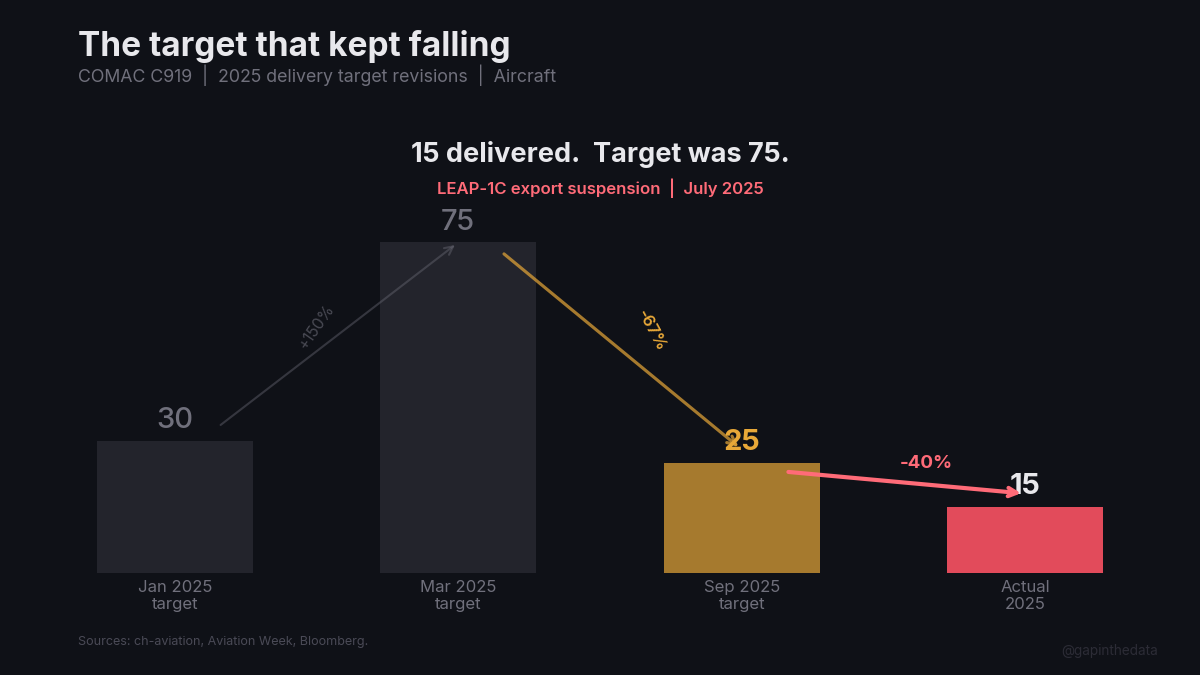
COMAC delivered fifteen C919 narrowbodies in 2025. The target was seventy-five. Beijing’s response, published today in the 15th Five-Year Plan, was to accelerate the CJ-1000A, the domestic engine that eliminates the C919’s dependence on Western suppliers.1
For Airbus, the implications fork. Near-term, every CJ-1000A that replaces a LEAP-1C frees an engine for CFM’s other customers, including the A320neo. Long-term, a COMAC that no longer needs US export licences is a COMAC whose production ceiling is set by Chinese industrial capacity, not American trade policy. The engine pool that was already binding loosens. The competitor unshackles.
I. The constraint
In January 2025, COMAC targeted 30 C919 deliveries. By March: 75. By September: 25.2 The actual outcome was 15.3
The C919 flies on CFM International’s LEAP-1C, the sole engine option. When the US suspended LEAP-1C export licences in July 2025, production halted.2 Forecast International estimates 55% of C919 component suppliers are US-based; only 25% are Chinese.4 The three carriers that had expected 32 deliveries received five by September.2 Nine of the fifteen came in Q4, after the suspension was lifted.5
The Five-Year Plan did not set a production target. It set a production strategy: accelerate the CJ-1000A, reduce reliance on Western suppliers across engines, avionics, and flight systems, and expand assembly capacity.1
II. The mechanism
The CJ-1000A is the domestic engine programme that AECC, the Aero Engine Corporation of China, has been developing since 2016. Design is finalised. AECC is working toward CAAC airworthiness certification. OAG Aviation estimates initial deliveries in 2027 or 2028, with mass production from 2030.6
Brian Yang Bo frames it as a “backup, not replacement.” He adds: “supply-chain stability boils down to this."1 A backup engine that passes CAAC certification is a replacement engine the moment the primary becomes unavailable. The US demonstrated that moment in July 2025, and the export licence regime gives Washington the authority to reimpose it at will.2
Two things were absent from the Five-Year Plan’s engine language. No mention of European certification for the CJ-1000A. No mention of overseas orders for CJ-1000A-powered aircraft. Every confirmed C919 order is from a Chinese entity.7 A CJ-1000A that passes CAAC, without EASA, without FAA, is sufficient for the entire order book.
III. The fork
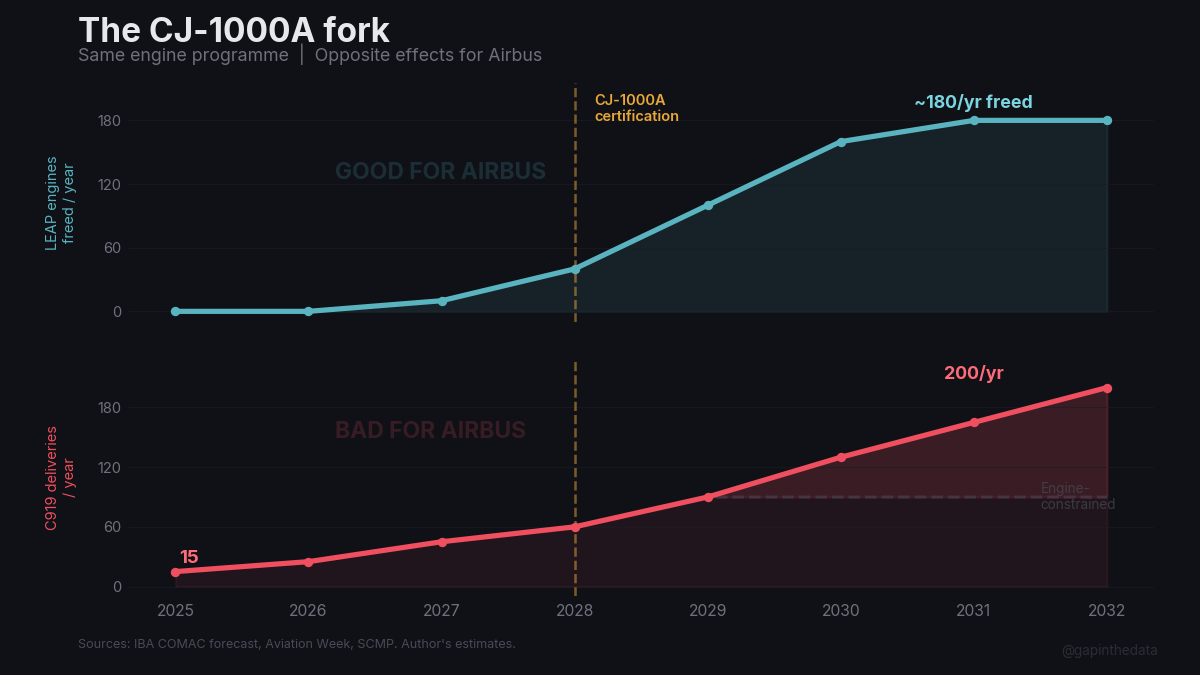
Near-term (2028–2030): the engine pool loosens. In What Safran Can’t Fix, I mapped five claims competing for every LEAP engine CFM builds. Claim 2 was COMAC: approximately 30 LEAP-1C engines in 2025, scaling toward 60–90 per year as production ramps.8 The CJ-1000A removes Claim 2 from the pool.
Those engines do not flow automatically to Airbus. Boeing is ramping the 737 MAX from 42 to 53 per month, each aircraft absorbing two LEAP-1Bs.8 Safran projects LEAP aftermarket revenue will more than triple between 2024 and 2028, targeting propulsion margins of 22–24%.9 Freed LEAP-1C capacity enters a pool where every other claim is also growing. The constraint loosens. It does not disappear.
Long-term (2030+): the chokepoint closes. The July 2025 LEAP-1C suspension demonstrated leverage: Washington could halt C919 production at will.2 With the CJ-1000A in mass production, that lever breaks.
What Airbus loses is not an engine allocation. It is the fact that its largest emerging competitor was bottlenecked by a dependency the West controlled. IBA forecasts 90 C919 deliveries per year by 2030, engine-constrained.10 Remove the bottleneck and the constraint shifts to what China controls: final assembly capacity, airframe supply chain, political will. The Five-Year Plan targets assembly capacity expansion and indigenisation of avionics and flight systems alongside engines, addressing each remaining constraint by name.1 The domestic market alone, 9,500 new aircraft over twenty years per Faury’s own estimate, sustains the programme without a single export order.11
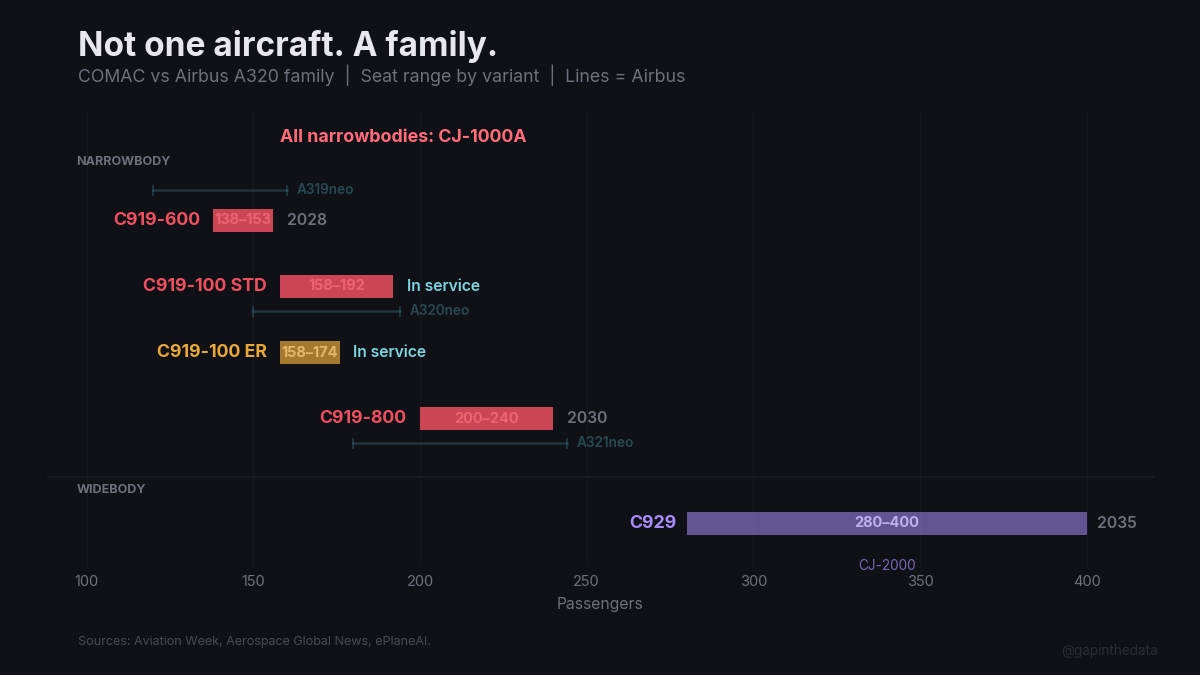
COMAC has built a three-variant narrowbody family in two years: the standard C919, a shortened C919-600, and a stretched C919-800.12 13 14 The family covers 138 to 240 seats, and the CJ-1000A powers all of it, enabling a production programme that could exceed 200 aircraft per year.
Transition (2028–2032). Early CJ-1000A-powered C919s will fly alongside LEAP-1C aircraft, the ratio shifting as AECC scales. How CFM manages a winding-down LEAP-1C customer, reallocating to LEAP-1A and LEAP-1B or absorbing the decline, shapes how much of the freed pool reaches other customers.
The risk. The fork’s long-term arm depends on the CJ-1000A working. If the engine arrives late, underperforms, or carries reliability penalties, the LEAP-1C dependency persists and the fork collapses to its near-term arm only. China has not previously mass-produced a commercial turbofan at this thrust class. C919 utilisation sits at 2.6 hours per day against a narrowbody benchmark of seven; the aircraft is immature even with proven Western engines.10 The Five-Year Plan is a statement of intent, not a statement of capability.
IV. The propulsion vector
AVIC co-funded AECC with $7.5 billion in 2016.15 AECC builds the CJ-1000A. AVIC is simultaneously Airbus’s largest non-engine supplier, producing sole-source A350 composite structures and A320 wing components, and, since July 2025, equipping A321 fuselages at Tianjin.16
The CJ-1000A has completed flight testing on Y-20 transports. AECC’s Wu Guowei said it would power C919 verification flights “soon."3 If the engine works, the competitor Airbus faces in China is no longer constrained by a foreign engine supplier. It is constrained only by the rate at which Chinese industry can build.
Footnotes
1 South China Morning Post, March 12, 2026. 15th Five-Year Plan (2026–2030): accelerated C919 production, CJ-1000A certification, reduced reliance on Western suppliers across engines, avionics, and flight systems, assembly capacity expansion. Brian Yang Bo: “candid admission of the challenges it has faced”; CJ-1000A “backup, not replacement”; “supply-chain stability boils down to this.”
2 ch-aviation, September 29, 2025. Target revisions: 30 (January) to 75 (March) to 25 (September). LEAP-1C suspension July 2025 (resumed). Honeywell/Collins disruptions. Airlines expected 32, received 5 by September. Actual outcome: 15 deliveries. Bloomberg reporting.
3 Aviation Week, January 15, 2026. 15 C919s delivered in 2025. CJ-1000A: Wu Guowei (CJ-1000A to power C919 verification flights “soon” following Y-20 tests). Shi Jianzhong: “fared better than my most optimistic expectations.”
4 CSIS, “China’s COMAC: An Aerospace Minor Leaguer,” Scott Kennedy, December 7, 2020. Forecast International (2025): 55% US-based suppliers, 25% Chinese. Cumulative government support $49–72 billion.
5 Aviation Week Fleet Discovery; Bloomberg, February 9, 2026. Nine of fifteen C919 deliveries in Q4 2025.
6 OAG Aviation, Mayur Patel, January 2026. CJ-1000A initial deliveries likely 2027 or 2028; mass production from 2030. Aviation Week (January 2026): Shi Jianzhong and Wu Guowei quotes on programme progress.
7 Reuters/EASA, April 29, 2025. EASA executive director Florian Guillermet: certification “within three to six years” (2028–2031). All confirmed C919 orders from Chinese entities. COMAC not pursuing FAA certification as of April 2025.
8 CFM International produces the LEAP-1A (A320neo), LEAP-1B (737 MAX), and LEAP-1C (C919) on shared production infrastructure. Variant allocation is adjusted based on demand. Boeing 737 MAX: 42/month current, targeting 52–53 by 2027. See What Safran Can’t Fix.
9 Safran FY 2025, February 13, 2026. LEAP aftermarket revenue projected >3x from 2024 to 2028. Propulsion operating margin 22–24% (2025–2028e). Third-party MRO share rising from 10% (2024) to 30% (2030). See What Safran Can’t Fix.
10 IBA Group, “COMAC Aircraft Programmes: Status & Outlook,” September 17, 2025. Forecast: 90 C919 deliveries per year by 2030. C919 utilisation 2.6 hours/day vs. ~7-hour narrowbody benchmark. COMAC projected to capture ~65% of new Chinese narrowbody deliveries by 2030.
11 Faury, World Governments Summit, Dubai, February 6, 2026. China needs “about 9,500 new aircraft over the next 20 years.” See The Tianjin Trap.
12 Aviation Week, January 22, 2026. C919-600 prototype B-002U spotted at Shanghai Pudong. Shortened fuselage (~34m vs. 38.9m standard), 138–153 passengers. High-altitude optimisation. First flight 2027, service 2028.
13 Aero News Journal, January 24, 2026. C919-600 jointly developed with Tibet Airlines (Lhasa, 3,570m elevation). 40 aircraft ordered.
14 Aerospace Global News, January 4, 2026. C919-800 stretched variant, 200+ passengers, developed with China Eastern Airlines. Service by 2030.
15 CSIS; DoD Federal Register (November 2020). AECC capitalised at $7.5 billion by AVIC and COMAC in 2016. AVIC designated PLA-linked entity.
16 ePlaneAI, July 16, 2025. Airbus expanded AVIC XAT partnership to A321 fuselage equipping at Tianjin: electrical, electronic, hydraulic, and flight control systems.