A Swiss A340 landed flapless twice in four days. The same pattern has appeared on six airframes, at six airlines, across three EASA airworthiness directives targeting the flap system’s design.
On March 10, 2026, Swiss flight LX283 from Johannesburg approached Zurich with its flaps frozen at position zero. The crew of HB-JMA, an Airbus A340-300, executed a high-speed, high-pitch landing without flap extension or trailing-edge deceleration surfaces, touching down well above normal approach speed on a widebody carrying a full long-haul load.1
The aircraft entered maintenance. Four days later, on March 14, HB-JMA departed Zurich as LX189 to Shanghai with 209 people on board. On approach back to Zurich, descending through 2,300 feet on final for runway 14, the crew discovered the flaps would not extend. They executed a go-around, climbed to 4,000 feet, repositioned, and landed on runway 16 at 169 knots.2
Normal approach speed for an A340-300 at landing weight is 135 to 145 knots. At 169 knots the aircraft crosses the threshold 25 to 30 knots fast, consuming roughly 40% more runway.3 The margins between a successful flapless landing and an overrun are determined by runway length, weather, and the crew’s ability to manage an energy state the aircraft was never meant to carry into the flare.
The aircraft sat on the ground for 22 hours, then underwent four days of additional maintenance before completing a test flight.2
HB-JMA is 22 years old, MSN 538, delivered to Swiss in June 2003.4 In March 2017, the same airframe performed an emergency descent from FL340 to FL100 in seven minutes near Dakar, diverting with 215 passengers after what Swiss described as a fuel pump irregularity.5 The aircraft has been flying long-haul revenue service continuously since.
I. The fleet
The standard framing for HB-JMA is “maintenance issue”: the operator failed to identify the root cause, and the same failure recurred. That framing requires the problem to be specific to one aircraft and one maintenance organisation. The incident record does not support it.
| Date | Operator | Registration | Route | Event |
|---|---|---|---|---|
| Mar 2026 | Swiss | HB-JMA | Shanghai→Zurich | Flaps stuck at 0. Go-around, landed 169kt.2 |
| Mar 2026 | Swiss | HB-JMA | Johannesburg→Zurich | Flaps stuck at 0. High-speed landing.1 |
| Apr 2022 | Lufthansa | D-AIGU | Frankfurt→Singapore | Flaps problem on departure. Fuel dump, return. On ground 17 hours.6 |
| May 2019 | Iberia | EC-IZY | Madrid→São Paulo | Flaps problem at FL350. Return to Madrid.7 |
| Mar 2018 | Lufthansa | D-AIGN | Frankfurt→Bogotá | Flapless landing at Frankfurt. No trailing edge flaps.8 |
| Apr 2017 | Surinam | PZ-TCR | Amsterdam→Paramaribo | Flaps failure. Returned. Maintained. Departed. Same failure recurred. Returned again.9 |
| — | Air Tahiti Nui | F-OJTN | Beijing→Papeete | Flaps problem on climb-out.10 |
| Jun 2019 | HiFly | — | Near Orlando | Hydraulic failure affecting flap system.11 |
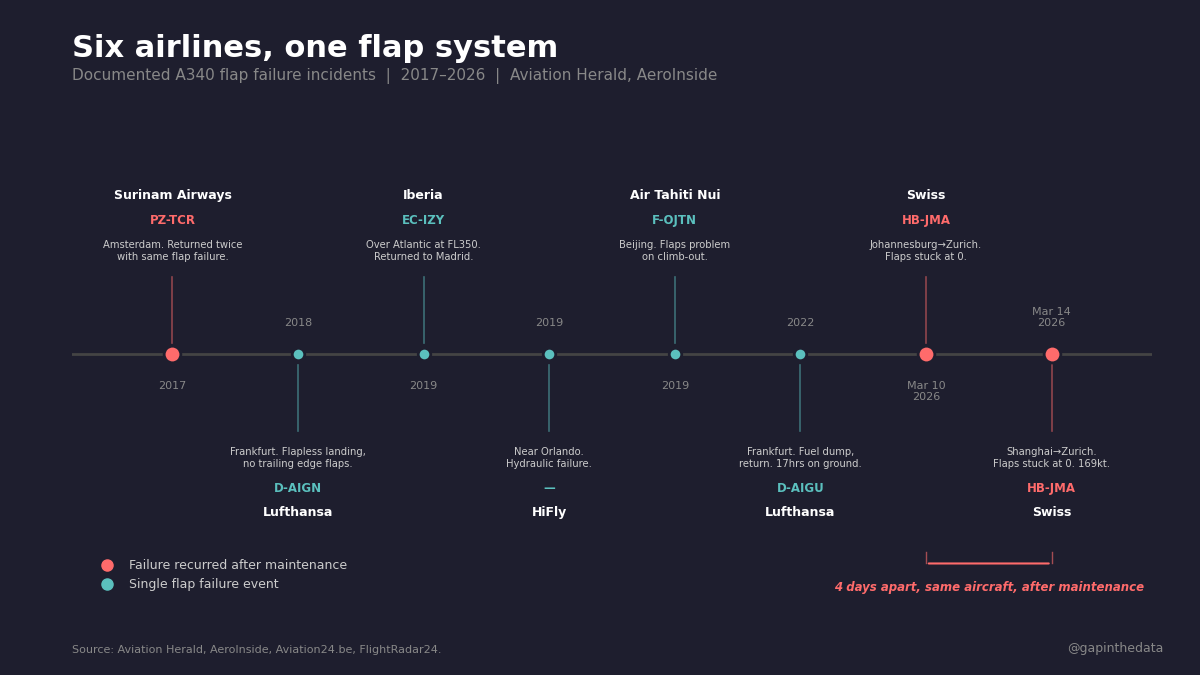
Eight documented events across six operators on six airframes: Swiss, Lufthansa, Iberia, Surinam Airways, Air Tahiti Nui, HiFly. The maintenance organisations, regulatory jurisdictions, and operational environments share nothing in common except the aircraft type.
The Surinam case is the structural twin of HB-JMA. In April 2017, PZ-TCR departed Amsterdam for Paramaribo, experienced a flaps failure, and returned. Maintenance was performed. The aircraft departed again and the same failure recurred, forcing a second return.9 Nine years before HB-JMA repeated the pattern in Zurich, a different operator in a different country with different mechanics experienced an identical failure-maintenance-failure sequence on the same aircraft type.
A maintenance-culture explanation requires the failure to be random and operator-specific. A failure that crosses six maintenance organisations on three continents, documented by EASA, the FAA, the Aviation Herald, and AeroInside across independent databases, is not random and not operator-specific.
II. The brake that was supposed to catch this
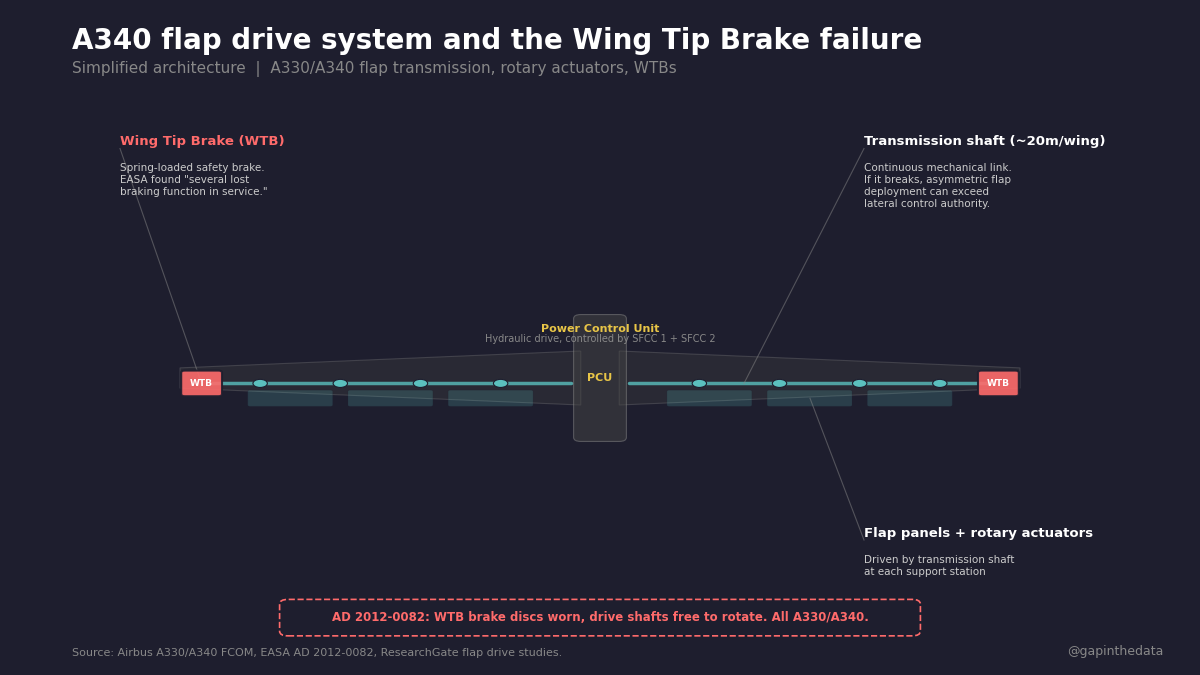
The A340’s flap system is mechanically driven by a continuous transmission shaft running approximately twenty metres from a central Power Control Unit through rotary actuators at each flap station.12 The shaft provides positive synchronisation between left and right wings. If it breaks, only flaps mechanically coupled to the surviving portion remain controllable, and asymmetric flap deployment at landing speeds produces rolling moments that can exceed the aircraft’s lateral control authority.13
The system’s safety architecture depends on Wing Tip Brakes. WTBs are spring-loaded, hydraulically released brakes installed at the outboard ends of the transmission shaft for both the flap and slat systems. They are pressure-off-brakes: the springs apply braking force by default, and hydraulic pressure controlled by the Slat Flap Control Computers releases the brakes during normal operation. If the SFCCs detect asymmetry, runaway, uncommanded movement, or overspeed, both computers must independently confirm the failure before energising the WTB solenoid valves to lock the transmission. Once activated in flight, WTBs cannot be released until the aircraft is on the ground.14
The WTB exists to catch every failure mode that matters: central drive failure, developing asymmetry, flap runaway. In 2010, EASA discovered it was failing silently across the fleet.
III. What EASA found
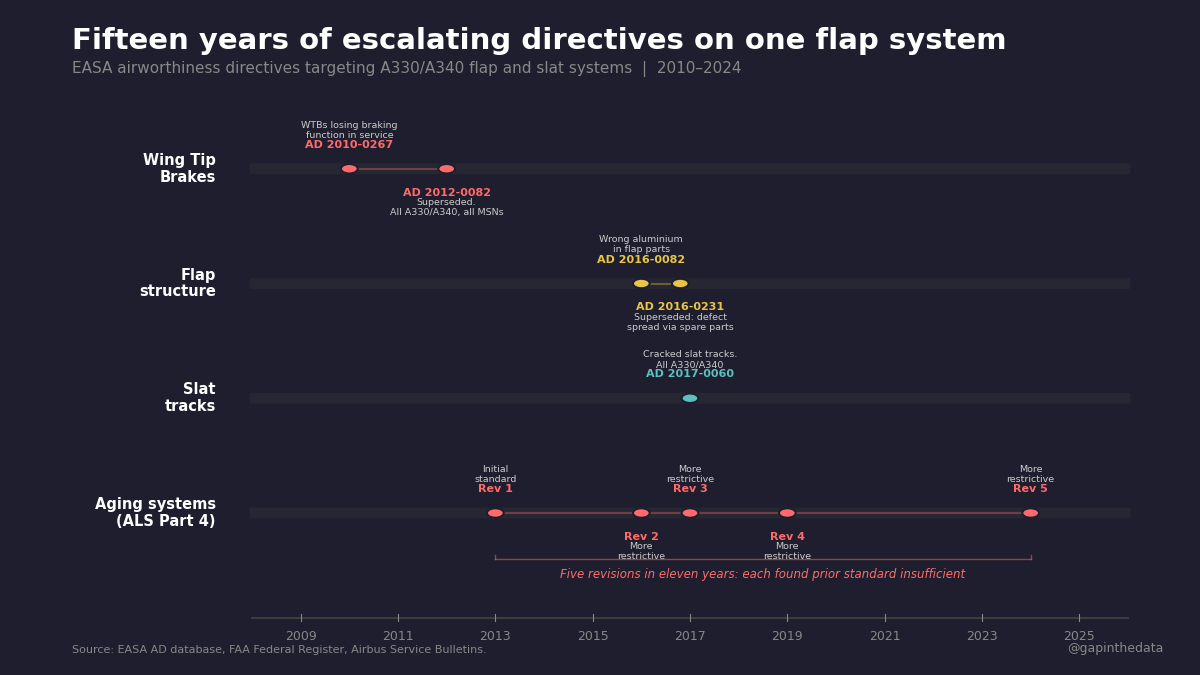
EASA AD 2010-0267, superseded by AD 2012-0082. Multiple Wing Tip Brakes had lost their braking function in service. Inspection by the manufacturer found the drive shaft free to rotate and the brake discs worn through.15 The WTBs were degrading undetected until they could no longer perform their function. The failure was latent: the brakes appeared normal during routine checks but could not arrest the transmission under load.
The AD applied to every A330 and every A340 ever built, all manufacturer serial numbers, every variant.15
Required action: repetitive operational testing of WTB performance every 1,000 flight hours, replacement of any WTB that failed the test, and eventual fleet-wide replacement terminating the repetitive inspections.15 Airbus issued Alert Operators Transmission A27L001-12 and Modification 43512 as the long-term fix.
The FAA adopted the corresponding AD in August 2013. Its stated purpose: “to detect and correct failure of the WTB and consequent loss of control of the airplane.”16 The regulatory determination was that the safety system designed to prevent catastrophic flap failure was itself failing fleet-wide, and that the consequence was loss of control.
EASA AD 2016-0082, superseded by AD 2016-0231. Nonconforming aluminium alloy was used to manufacture structural parts on the A330/A340 inboard flap, a manufacturing-origin defect. The first AD addressed aircraft that received the defective parts during production. The revision was necessary because EASA determined that affected flaps could also have been installed on other aircraft as spare parts, propagating the defect across the fleet through the maintenance system itself.17 The wrong material was installed at the Airbus factory, and the defect containment failed at the spare parts level.
EASA AD 2017-0060. Cracked slat tracks at the front stop attachment, discovered in service across the A330/A340 fleet. Required detailed inspections and repetitive special detailed inspections on all A330-200/300 and A340-200/300 variants.18
ALS Part 4: 2013, 2016, 2017, 2019, 2024. Five revisions to the Airworthiness Limitations Section governing aging-systems maintenance for the A330/A340, each introducing what EASA described as “new and more restrictive maintenance requirements and/or airworthiness limitations."19 Each revision was prompted by in-service findings that the prior requirements were insufficient. The 2016 revision superseded 2013. The 2017 revision superseded 2016. A regulator does not tighten the same standard five times because the airframe is aging as predicted.
Earlier ADs. Sheared attachment bolts at flap track sensor struts, risking flap drive disconnection and outboard flap separation. Failed down-drive bracket bolts at inboard flap track 1, causing flap-locked conditions.16 Each addressed a different component of the same system, each prompted by in-service failures the original design certification had not anticipated at the rates observed.
The cumulative picture is a flap system whose WTBs wear out silently, whose structural parts were built from the wrong material, whose slat tracks crack, and whose aging-systems maintenance requirements have been revised upward five times because each prior standard proved insufficient. Across this entire history, A340s operated by six different airlines have experienced flap failures serious enough to force flapless landings, go-arounds, diversions, and fuel dumps.
IV. What “maintenance issue” conceals
When the same failure recurs on the same aircraft after maintenance, there are three possibilities. The maintenance action addressed the wrong component. The maintenance action addressed the right component incorrectly. Or the root cause is not addressable through the maintenance actions available to the operator.
The third possibility is the one the “maintenance issue” framing cannot accommodate. If the WTBs degrade through normal wear at rates that exceed the inspection intervals, if the flap structural components were manufactured from nonconforming material that the operator had no way to detect without the eddy current inspection mandated years later by AD, if the aging characteristics of the flap drive system require maintenance intervals that have been revised upward five times because the original intervals were wrong, then the operator is maintaining to a standard set by the manufacturer and approved by the regulator, and the standard is insufficient.
Swiss maintains HB-JMA to the Airbus Aircraft Maintenance Manual. The AMM is written by Airbus, the maintenance intervals are set by Airbus, and the inspection procedures are defined by Airbus. The ADs that override the AMM when its standards prove insufficient are prompted by in-service failures that Airbus’s original certification analysis did not predict. The operator’s freedom of action is bounded by the manufacturer’s documentation. When the documentation is wrong, the operator executes incorrect maintenance correctly.
The Surinam pattern makes this concrete. PZ-TCR returned to Amsterdam with a flaps failure. Surinam’s mechanics performed the maintenance actions prescribed by the Airbus AMM. The aircraft departed and the same failure recurred.9 Nine years later, Swiss’s mechanics performed prescribed maintenance on HB-JMA after a flaps failure, the aircraft departed, and the same failure recurred.1 2 Two operators, two continents, nine years apart, an identical failure-maintenance-failure sequence. Either both maintenance organisations independently made the same error, or the prescribed maintenance actions do not reliably resolve the failure mode.
Airbus does not publish fleet-wide flap failure rates. European occurrence data, unlike the FAA’s Service Difficulty Reporting database, is not publicly accessible.20 The incidents in the table above are the ones that reached public reporting through Aviation Herald, AeroInside, and aviation news. The actual rate is unknown and unknowable from outside the manufacturer and the regulator.
V. The fleet that cannot retire
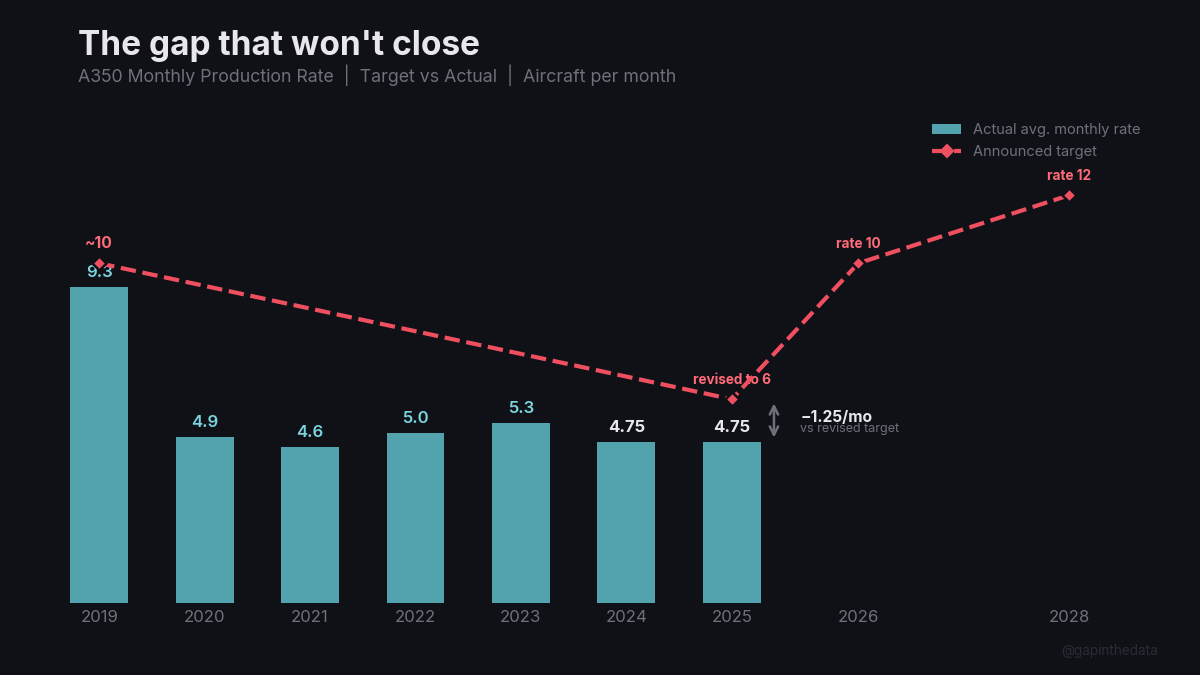
Swiss operates four A340-300s.21 It plans full withdrawal by mid-2027. The aircraft are being pushed through their final years of service because A350 deliveries are late. The A350 programme delivers at 4.75 per month against a target of 8, with the production queue stretching past 2040 at current rates. Swiss has no replacement widebody on the timeline it needs.
Lufthansa’s A340-300 fleet, aircraft of similar vintage, has accumulated a parallel record: engine shutdowns on D-AIGP in October 2023 and April 2024, engine failure plus hydraulic problems on D-AIGN in May 2025, engine shutdown on D-AIGM in September 2025.22 D-AIGN is the same airframe that lost its flaps on the Frankfurt-Bogota run in 2018; seven years later it was back over the Atlantic with an engine failure. Lufthansa plans to retire its A340-300s by 2027, on the same timeline as Swiss, constrained by the same A350 delivery bottleneck.
The A340 has been out of production since 2011. No new parts are being manufactured against active production contracts. The aftermarket supports the fleet, but aftermarket availability declines as operators retire aircraft and the installed base shrinks. Swiss’s four aircraft draw from a spares pool that gets smaller every year. The five claims on every LEAP engine that constrain the A320 ramp have a structural analogue here: competing claims on every A340 spare part from a fleet entering terminal decline.
The operators cannot retire the aircraft because the replacements are not available. They cannot ground them because four A340s is the minimum fleet for Swiss’s long-haul schedule. They maintain to standards set by a manufacturer that stopped building the type fifteen years ago, under ADs revised upward five times, with WTBs that were found failing silently across the global fleet, on flap structures built from the wrong aluminium. When the flaps freeze at zero, twice in four days, on the same aircraft, after maintenance, it is classified as an operator maintenance issue.
VI. The regulator
EASA issues the ADs but does not ground the fleet, does not require Airbus to disclose fleet-wide flap failure rates, does not mandate that European occurrence data be publicly accessible, and does not explain why five successive revisions to the aging-systems maintenance requirements were necessary or what in-service findings prompted each tightening.
EASA is funded 72 to 74% by fees charged to the industry it regulates. Airbus is the single largest fee-payer.20
This is the same EASA that terminated its own rulemaking on cabin air quality without mandating sensors, and whose occurrence database received zero of the 663 fume events documented by Germany’s BFU.20 The regulatory architecture and the structural relationship between manufacturer, regulator, and rules are identical. The difference in stakes is that fume events cause chronic neurological damage over years; a flap failure at 2,300 feet on approach causes acute loss of control in seconds.
The WTB AD used the phrase “loss of control of the airplane.” The regulator wrote those words, issued the directive, and approved the 1,000-flight-hour repetitive inspection interval. It approved the aging-systems maintenance revisions, each time acknowledging the prior standard was insufficient by replacing it with a more restrictive one. At no point did it require Airbus to explain why a safety-critical component was wearing out faster than predicted, or mandate public disclosure of the in-service failure data that prompted each successive AD.
The AD system works by reaction: something fails in service, the failure is reported (when it is reported), the manufacturer investigates, the regulator issues a directive. The question it cannot answer is how many unreported events occurred before the reported one triggered action. For the WTB failures, EASA’s own language says “several” had lost braking function before the AD was issued.15 Several is not a number.
The declarations said none. The maintenance rules said minor comfort issue. The aging-systems standard said sufficient five times and was wrong each time.
HB-JMA will return to service. Swiss needs the aircraft. The replacements are stuck in a production queue that the manufacturer cannot accelerate because the engines are claimed five times over, the fuselage supplier is absorbed at a nine-figure annual loss, and the raw materials arrive through a contested strait.
The flaps will be repaired to the standard in the Airbus maintenance manual, the standard that was insufficient for PZ-TCR in 2017, that has been revised upward five times since 2013, that is set by the manufacturer and approved by the regulator it funds, and that applies to an aircraft Airbus stopped building fifteen years ago.
Footnotes
1 Turbine Traveller, “Flaps Failure Twice in 4 Days on Swiss A340,” March 2026. HB-JMA, LX283 Johannesburg→Zurich, March 10, 2026. Flaps stuck at 0, high-speed high-pitch landing.
2 Aviation Herald, “Incident: Swiss A343 at Zurich on Mar 14th 2026, flaps problem,” March 2026. HB-JMA, LX189 Shanghai→Zurich, 209 persons on board. Flaps inoperative on approach to runway 14 at approximately 2,300 feet. Go-around, repositioned, landed runway 16 at approximately 169 knots. Aircraft on ground 22+ hours, then 4 days maintenance, test flight. See also News.az.
3 Landing distance increases approximately with the square of approach speed. At 169kt versus a baseline 140kt, the ratio is (169/140)^2 = 1.46, implying ~46% more runway consumed before braking authority equalises. Operational margins depend on runway length, surface condition, crosswind, and brake energy remaining. Zurich runway 16 is 3,700 metres.
4 Flightradar24, HB-JMA aircraft page. Airbus A340-313, MSN 538, delivered June 2003. Age: approximately 22 years and 9 months.
5 AeroInside, “Swiss A343 near Dakar on Mar 13th 2017, emergency descent,” March 2017. HB-JMA, LX-92 Zurich→São Paulo, 215 passengers. Emergency descent FL340→FL100 in 7 minutes near Dakar, Mauritanian airspace. Diverted to Dakar. Swiss reported “fuel pump technical irregularity.”
6 AeroInside, “Lufthansa A343 at Frankfurt on Apr 3rd 2022, flaps problems on departure,” April 2022. D-AIGU, LH-778 Frankfurt→Singapore. Flaps problem during climb from runway 18. Stopped climb at FL140, entered hold to dump fuel, returned to Frankfurt, landed runway 25C approximately 105 minutes after departure. On ground approximately 17 hours.
7 AeroInside, “Iberia A346 over Atlantic on May 21st 2019, flaps problem,” May 2019. EC-IZY, IB-6827 Madrid→São Paulo Guarulhos. Flaps problem at FL350, approximately 580nm southwest of Madrid. Returned to Madrid, landed runway 32L. See also Aviation Herald, avherald.com/h?article=4c83bdca.
8 Airport Webcams / FlightRadar24 tracking, March 28, 2018. D-AIGN, LH542 Frankfurt→Bogotá. Flaps problem shortly after departure. Held over Dutch coast to lower landing weight. Returned to Frankfurt, landed without trailing edge flaps. Slats (leading edge, flap 1) available.
9 Aviation24.be, “Surinam Airways returns twice to Amsterdam Schiphol after flaps issues,” April 2017. PZ-TCR, PY-993 (codeshare TUI OR-9301) Amsterdam→Paramaribo. First return: flaps failure. Maintenance performed. Second departure: same failure recurred. Levelled at FL100, fuel dump over North Sea, second return to Schiphol. Aircraft had returned from maintenance at Malta Airport two days prior.
10 AeroInside, flaps problem cause page. Air Tahiti Nui A340-300 F-OJTN, charter flight TN-702 Beijing→Papeete. Flaps problem on climb-out. Full details behind AeroInside paywall.
11 Aviation Herald, “Incident: HiFly A343 near Orlando on Jun 29th 2019, hydraulic failure,” June 2019. Hydraulic failure affecting flight control surfaces including flaps.
12 ResearchGate, “Architecture of a conventional flap drive system (A330/A340).” Central Power Control Unit drives transmission shaft through bevel gear boxes and rotary actuators at each flap support station. Shaft length approximately 20 metres per wing.
13 Airbus patent literature and flight control system documentation. Asymmetric flap deflection: “can lead to critical flight conditions, which are no longer controllable.” WTBs and monitoring systems designed to detect and arrest asymmetry before control authority is exceeded.
14 EASA AD 2012-0082; ResearchGate, “Wingtip brake architecture.” WTB: Pressure-Off-Brake with multi-plate friction device, spring-pack operated. Released by dual hydraulic pistons controlled by SFCC-energised solenoid valves. Activation conditions: asymmetry, runaway, uncommanded movement, overspeed. Cannot be released in flight; ground reset only. Separate WTB sets for flap and slat systems.
15 EASA AD 2012-0082 (superseding AD 2010-0267), dated May 15, 2012. “Several wing tip brakes (WTB) have lost their braking function in service. Inspection by the manufacturer of these units revealed that the drive shaft was found free to rotate and the braking discs worn.” Applicability: all A330-200/300, A340-200/300, A340-500/600 series, all MSNs. Required: repetitive WTB operational tests at intervals not exceeding 1,000 flight hours per AOT A27L001-12. Replacement of any WTB failing the test. Eventual fleet-wide replacement (Mod. 43512) terminating repetitive tests.
16 FAA, Federal Register, Airworthiness Directive, August 30, 2013. Adopted EASA AD 2012-0082 for US-registered aircraft. Purpose: “to detect and correct failure of the WTB and consequent loss of control of the airplane.” Earlier A330/A340 flap ADs: sensor strut bolt failures (flap drive disconnection risk, outboard flap separation), inboard flap track 1 down-drive bracket bolt failures (“flap-locked” condition, reduced controllability). See also FAA AD 2009-04-06 and AD 2006-12-28.
17 FAA, Federal Register, Airworthiness Directive 2017-06-07 (superseded 2023). Nonconforming aluminium alloy in A330/A340 inboard flap structural parts. EASA AD 2016-0231 (superseding AD 2016-0082). Required: identification of affected parts, eddy current inspection, replacement with serviceable parts. Revision prompted by determination that affected flaps “could be installed on airplanes as spare parts” beyond original production scope.
18 FAA, Federal Register, Airworthiness Directive, September 10, 2018. EASA AD 2017-0060, April 7, 2017. Cracked slat tracks at front stop attachment. Applicability: all A330-200/300 and A340-200/300 series. Airbus SBs A330-57-3123 and A340-57-4130.
19 EASA ADs 2013-0268/0269, 2016-0011/0012, 2017-0228, and subsequent revisions. ALS Part 4 aging-systems maintenance requirements for A330 and A340 fleets. Each revision introduced “new and more restrictive maintenance requirements and/or airworthiness limitations,” superseding prior ADs. FAA correspondence: AD 2015-16-02; AD 2017-25-13; proposed AD February 2026 superseding AD 2014-16-22 and AD 2017-25-13.
20 EASA occurrence data not publicly accessible, unlike FAA SDR database. EASA funding: 72-74% from industry fees (EASA Annual Accounts 2020-2022, European Parliament filings). Airbus is the single largest fee-payer. German BFU: 663 documented fume events, zero reported from BFU investigations to EASA’s ECCAIRS database. See Minor Comfort Issue, footnotes 19-20.
21 Swiss operates four A340-300s. Full A340 withdrawal planned by mid-2027. See Aviation.Direct, “Swiss: Staff shortages and technical failures force adjustments to the 2026 summer flight schedule.” See also AeroSpace Global News, “Rare quadjet: Can you still fly an Airbus A340 in 2026?”
22 Lufthansa A340-300 engine incidents: D-AIGP LH758 Frankfurt→Chennai, October 2023, engine return; D-AIGP LH759 Chennai→Frankfurt, April 2024, emergency diversion to Kuwait City; D-AIGN LH405 New York→Frankfurt, May 2025, engine #2 failure at FL350 plus hydraulic problems; D-AIGM LH432 Frankfurt→Chicago, September 2025, engine #1 shutdown on initial climb. See ePlane AI; AirLive; Aviation Herald May 2025.