What AirInsight didn’t tell you about Air Canada’s “safe choice”
AirInsight published a piece today calling the A350-1000 “a safe choice of a mature and very capable widebody.” Richard Schuurman’s fleet logic is perfectly competent. The 777-300ER needs replacing. The 777X timeline is blurred. The A350-1000 has the range. On the Air Canada side of the equation, the analysis holds up.
The article does not examine the Airbus side.
Somewhere between the press quotes and the seat-count arithmetic, the filing cabinet stayed closed. The FAA’s, EASA’s, and Airbus’s own financial statements were left unread. Open them and “safe choice of a mature widebody” starts to read differently.
The order that isn’t new
AirInsight notes, correctly, that “the order has been in the undisclosed backlog since November 14.” Then moves on.
Airbus’s own press release confirms it: this order was booked three months ago. What happened today is that Air Canada agreed to put its name on it. Bloomberg ran “Airbus Wins Major Order.” What Airbus actually won was a disclosure. It arrived one week after its worst January delivery month since COVID (19 aircraft total, one single A350),1 and one week before it reports FY2025 financial results on February 19.
The stock moved +2% on an order already in backlog.
What the FAA thinks “mature” means
This is what AirInsight’s article does not mention. Not in passing, not in a footnote, not at all.
On December 29, 2025, six weeks before today’s announcement, the FAA published Airworthiness Directive 2025-25-12. It applies to every A350-941 and A350-1041 ever built, every one, in any category.
The triggering event: an A350 lost control of an outboard aileron surface in flight. Investigation traced the cause to hydraulic fluid contaminating an electronic card inside a Flight Control Remote Module, the component responsible for managing ailerons, elevators, and rudders.
The FAA’s language, from the Federal Register:
“This condition, if not detected and corrected, could lead to runaway of rudder or elevator surface, resulting in loss of control of the airplane.”
The language is the FAA’s, not editorial. Every operator on earth must install a software fix or ground the aircraft.
It gets materially worse. The investigation determined that contamination occurred during manufacturing:
“EASA determined that certain servocontrols were exposed to hydraulic contamination before delivery of the airplane to its first operator.”
The defect was baked in at the factory: aircraft were delivered to airlines with contaminated flight control modules, a production quality escape that required two successive airworthiness directives. First, an interim AD in July 2025 mandating hardware replacements at up to $111,276 per aircraft.2 Then a final AD in December mandating permanent software modifications across the global fleet.
Compliance deadline: January 13, 2026.
One month later, Airbus published a render of an Air Canada A350.
It wasn’t just one directive
The flight control issue was the most severe, but it wasn’t isolated. In the eight months before today’s announcement, the A350 accumulated a pattern of regulatory actions that no article calling it “mature” should omit.
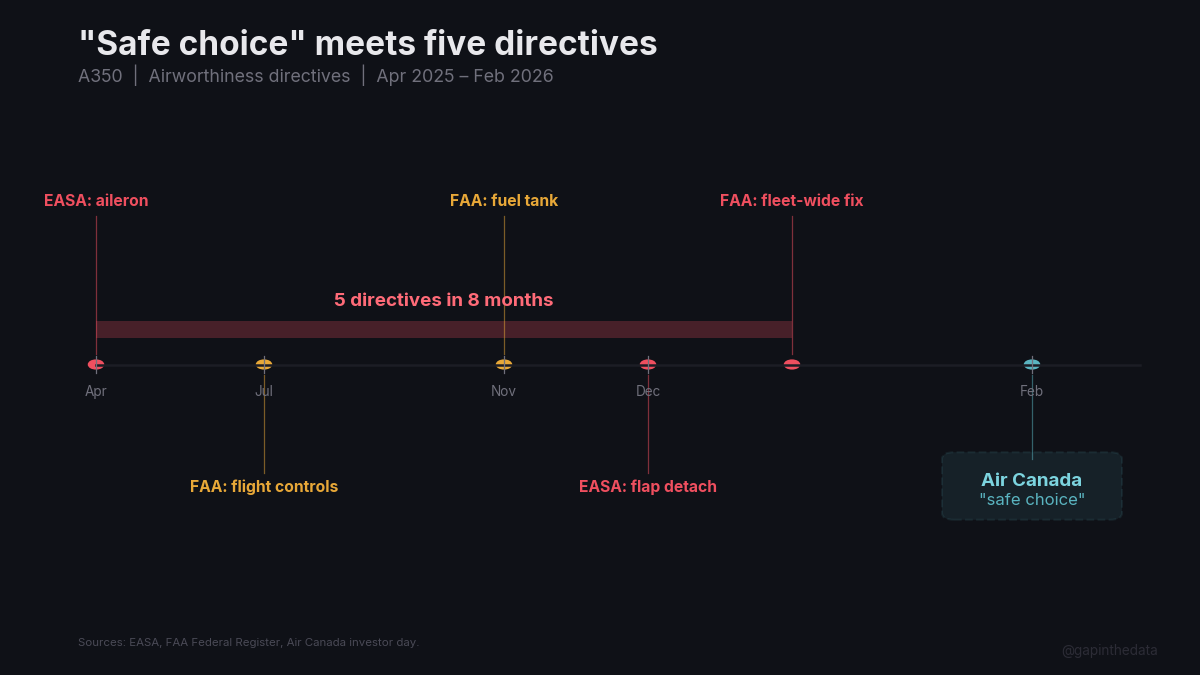
April 30, 2025: EASA issued an emergency airworthiness directive, bypassing public comment due to urgency, after an A350 aileron loss-of-control event traced to hydraulic contamination of FCRM electronic cards. Aviation Week reported the finding: “An occurrence was reported of loss of control of an outboard aileron surface. Due to similarity of design, elevator and rudder FCRM could be subject to the same failure mode… possibly leading to loss of control of the airplane.”
July 10, 2025: The FAA followed with interim AD 2025-13-12, requiring physical replacement of affected elevator FCRMs and prohibiting module swaps between control surfaces. Per the FAA’s own cost estimate: up to $111,276 per aircraft for the hardware work alone.2
November 25, 2025: The FAA superseded a 2023 airworthiness directive concerning missing or incorrectly applied sealant in A350 wing tanks. That an AD from two years prior required superseding tells you the original corrective action wasn’t sufficient.
December 2, 2025: EASA mandated inspections of all A350 APU air intake flaps after Airbus reported two in-service incidents where the flaps physically detached from the aircraft during operation. Root cause: cracked hinges from corrosion pitting.3 Operators now face initial inspections within 4 to 12 months and recurring checks every 24 months, fleet-wide.4
December 29, 2025: The FAA issued the final AD for the FCRM flight control runaway hazard, mandating permanent software installation (PRIM P14.1.3 and SEC S14.1.2) and prohibiting reversion to earlier standards.
Five regulatory actions in eight months, including two emergency directives, a factory-origin defect affecting the entire fleet, and components separating from aircraft in flight.
AirInsight’s article contains the word “mature” but not the word “airworthiness.” It contains the word “safe” but not the letters “FAA.”
The economics that Airbus actually reports
AirInsight quotes Air Canada’s executive describing the A350-1000’s “proven economics.” The airline’s economics may well improve. The manufacturer’s economics on this programme tell a different story, and you can read it on airbus.com.
H1 2025: Commercial aircraft EBIT adjusted fell 12% year-on-year, from 1,954 million to 1,714 million. Airbus attributed the decline to lower deliveries.5
9M 2025: Deliveries recovered, but Airbus noted the improvement “embeds an unfavourable mix.” That is Airbus’s own language for what happens when more A350s enter the delivery stream. They dilute margins relative to A320s. In the same results, Airbus stated: “Specific supply chain challenges, notably with Spirit AeroSystems, are putting pressure on the ramp up of the A350 and the A220."6 The full composition of the FY2025 results, and what they reveal about per-aircraft margins, is examined in detail here.
Spirit AeroSystems, whose A350 fuselage operations in Kinston and St. Nazaire Airbus absorbed, carried an FY2024 integration cost guidance of “mid triple digit negative” free cash flow impact. That’s 400 to 600 million, conservatively. Through nine months of 2025, Airbus booked 88 million in “Spirit AeroSystems work packages stabilisation costs.” A line item that didn’t exist before the acquisition and hasn’t stopped growing.7
These are not analyst estimates or short-seller claims. They’re verbatim from airbus.com results presentations. AirInsight cited none of them.
The production queue
AirInsight writes that Air Canada’s first A350-1000 deliveries “will start in the second half of 2030” and that by then the aircraft “should include” the latest Rolls-Royce XWB-97. That word “should” is asked to carry a lot of weight.
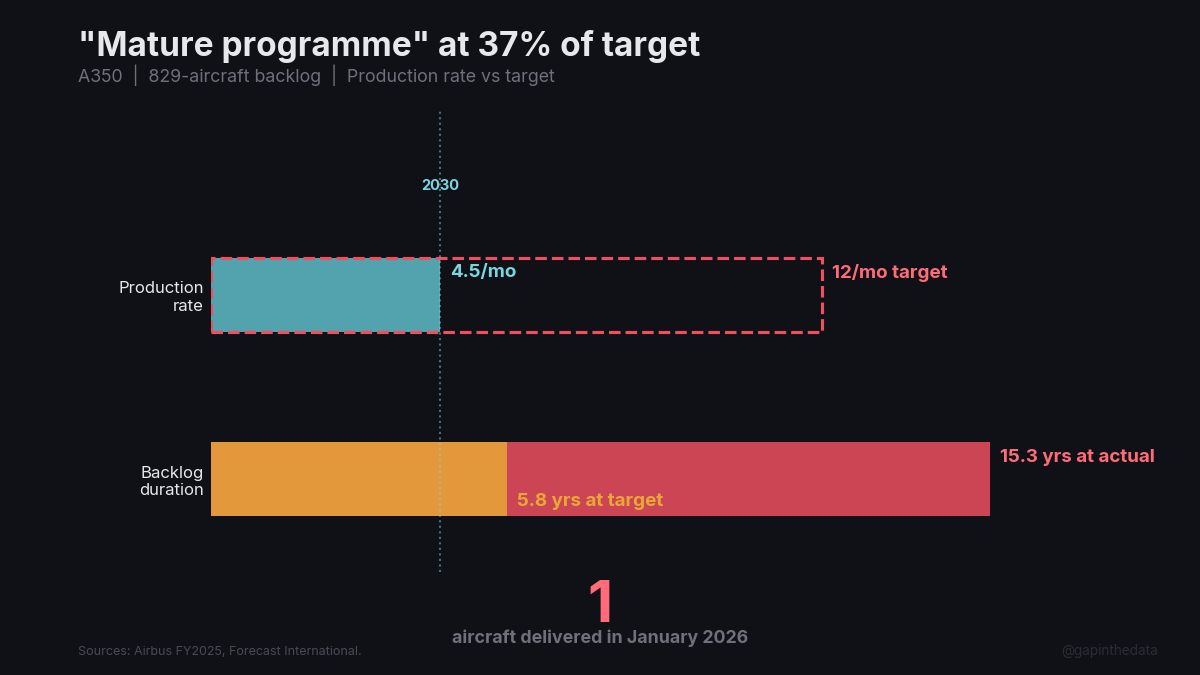
The A350 backlog stood at 829 aircraft in January 2026. In that same month, Airbus delivered one.1 For the full year, production averaged approximately 4.75 per month against a stated target of 6. Airbus continues to target rate 12 by 2028, having targeted this figure, and failed to reach it, repeatedly.7 And demand fragility is compounding the production problem: United Airlines has since removed 45 A350-900s from its fleet plans entirely.
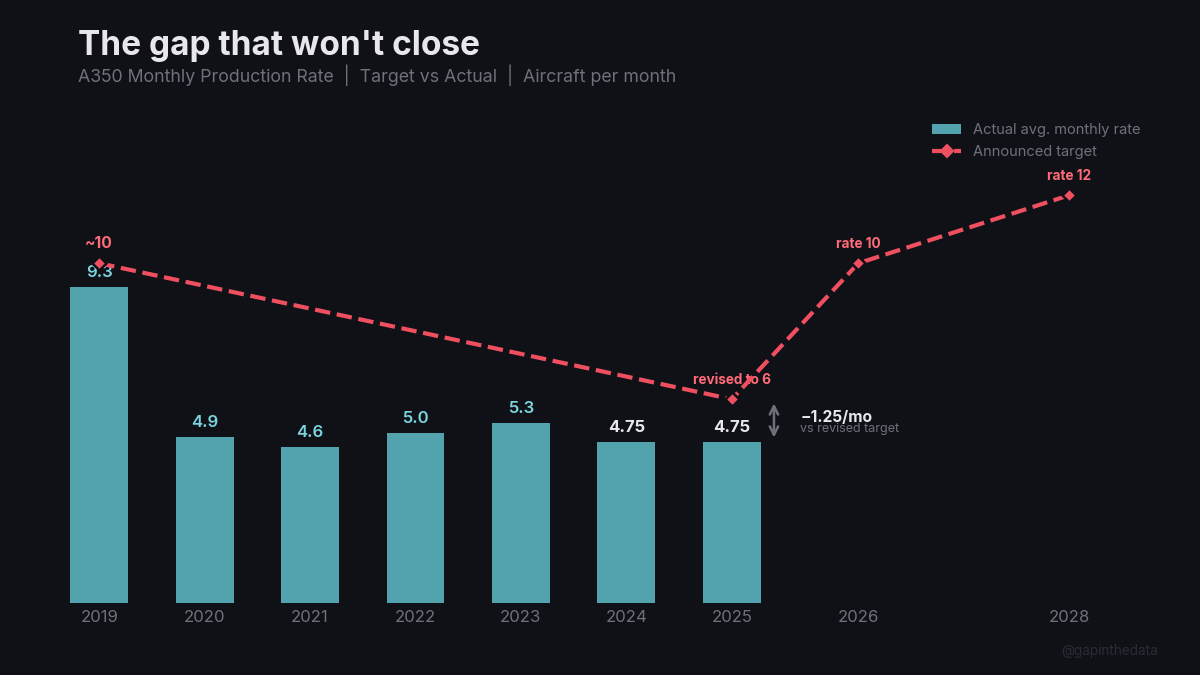
At 4.75 per month, 829 aircraft is over 15 years of production. Even at the aspirational rate 12, which would require nearly tripling current output, the backlog represents close to six years. Air Canada’s H2 2030 slot sits at the outer boundary of what the production schedule can credibly accommodate, before accounting for every airline ahead of it in the queue.
The article doesn’t interrogate whether the delivery timeline is realistic. It simply states it.
The options that aren’t orders
AirInsight’s opening paragraph mentions “purchase rights for eight additional units.” It never returns to the subject.
Under Airbus’s published revenue recognition policy, consistent since at least 2006 (governed by IAS 18 until 2018, then IFRS 15), options are not included in orders booked. They do not appear in year-end backlog. They generate no contract liability, no advance payment, and no revenue until exercised and delivered.7
Bloomberg’s “$3 billion” valuation, sourced to Ishka, assumes all 16 aircraft at list-adjacent pricing, but the firm order is for 8 aircraft, and the other 8 are a contractual right that exists on paper and nowhere on Airbus’s balance sheet. Media reported “up to 16.” Airbus booked 8.
What “safe choice” means
Air Canada’s fleet logic is sound. I’ll say it plainly: the A350-1000 is probably the right aeroplane for the mission. The 777-300ER replacement case is real, the 777X timeline uncertainty is real, and the A350-1000’s range profile genuinely opens routes from Canadian hubs that the current fleet can’t serve efficiently.
But calling the programme a “safe choice of a mature widebody” without acknowledging that the FAA determined a manufacturing defect could cause loss of aircraft control. Without mentioning five airworthiness actions in eight months. Without noting that Airbus’s own financial results describe A350 deliveries as margin-dilutive. Without observing that the programme runs at 37% of its stated production target with a fuselage supplier absorbed at a nine-figure annual loss. That is not analysis.
The A350 may be the right aircraft for Air Canada. The question the article did not ask is whether it is the right programme for Airbus: at these margins, at this production rate, with these integration costs, with sole-source composite structures manufactured by its competitor’s founding shareholder, delivering into a backlog that stretches toward 2040. The structural margin compression across all three ramp-up programmes is the subject of a separate analysis.
Sources
1 Forecast International, “Airbus and Boeing Report January 2026 Commercial Aircraft Orders and Deliveries,” February 10, 2026.
2 FAA, Airworthiness Directive 2025-13-12, Federal Register Vol. 90, No. 130, July 10, 2025.
3 Aviation Week, “EASA Orders Airbus A350 APU Flap Checks,” December 10, 2025.
4 Airguide, “EASA Mandates APU Flap Inspections on Airbus A350 After In-Service Incidents,” December 4, 2025.
5 Airbus, “Airbus Reports Half-Year (H1) 2025 Results,” airbus.com, July 30, 2025.
6 Airbus, “Airbus Reports Nine-Month (9M) 2025 Results,” airbus.com, October 29, 2025.
7 Airbus, “Airbus Reports Full-Year (FY) 2024 Results,” airbus.com, February 2025.