Finnair needed narrowbodies by 2027. Airbus had slots in 2032. So Finnair bought Embraers and used Airbuses from the secondary market. Airbus got neither order.
On March 23, 2026, Finnair announced its largest fleet investment in a century: 18 firm Embraer E195-E2s, with options for 16 more and purchase rights on 12 beyond that, for a potential fleet of 46.1 Separately, the airline issued an RFP for up to 12 used A320 and A321ceo aircraft from the secondary market.2 Total investment through 2029: approximately two billion euros.1 CEO Turkka Kuusisto called it “one of the largest investments in Finnair’s 102-year-old history."1
The order did not go to Airbus. The used aircraft are previous-generation Airbuses, not neos. Both decisions trace to the same constraint: no A320neo delivery slots before 2032.
The gap
Finnair’s narrowbody fleet consists of A319s and A320s averaging 23 years of age, with the oldest frames dating to 2000 and 2001.2 These aircraft need replacing by 2027-2028. Airbus has no A320neo delivery slots available until 2032 at the earliest, and Boeing has no 737 MAX slots until 2033.1 2
The gap between need and availability is six to seven years. No airline can operate 25-to-30-year-old narrowbodies while waiting for a slot.
Finnair’s solution is two-track. The Embraer E195-E2s deliver starting Q3 2027, with a cadence of 3/6/6/3 across 2027-2030.1 The used A320/A321ceos bridge the immediate capacity need. CRO Jaakko Rovelli: “We’ve been tracking the market for quite a while, and we’ve been pretty pleased with the developments that we’ve seen in it recently, in terms of availability and pricing."2
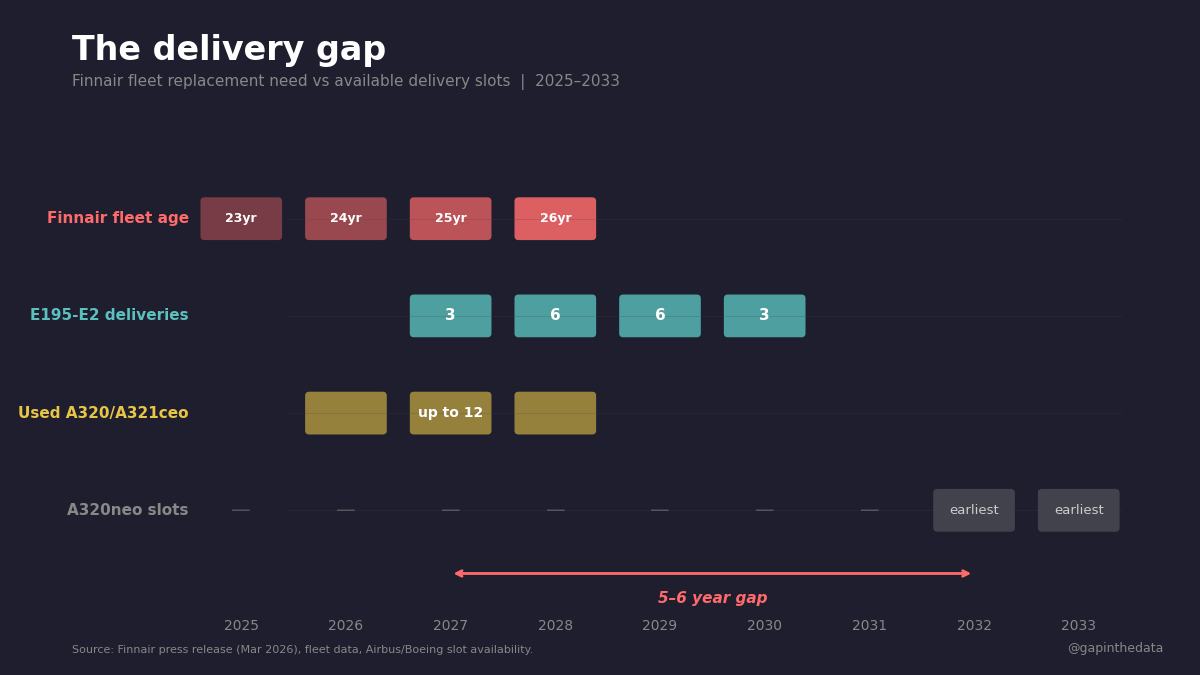
The two-track structure is itself the story. Finnair could not get new Airbus narrowbodies. It could not get new Boeing narrowbodies. So it bought new aircraft from the manufacturer with near-term slots, and old aircraft from the secondary market that Airbus created two decades ago. Airbus’s production in the early 2000s supplies the used market. Airbus’s backlog in the mid-2020s prevents it from supplying the new one.
Why not the A220
Finnair evaluated it. Rovelli was specific: “The A220 has a longer range; it carries more people. But the question was, was that something that was best suited to our network or not?"3
The network fit is real. Finnair’s Nordic and European routes suit the E195-E2’s 134-seat, shorter-range profile. The A220-300 carries 130-160 passengers over longer distances, capabilities Finnair did not need to pay for. The price differential reinforces the fit: the E195-E2 lists at approximately $71 million against the A220-300’s approximately $93 million, a 24% discount before negotiation.4
But the A220’s problem is not just network fit. The programme took a five-hundred-million-euro impairment in FY2025. The rate target has slipped from 14 per month to 12 for 2026, with a partial recovery to 13 targeted by 2028.5 The CEO of Airbus declined to provide a breakeven date for a programme the company has operated for seven years.5 Quebec wrote off C$400 million from its investment.6 The A220 had zero new orders in all of 2025, the worst year in the programme’s history.7
The programme shares PW1500G engines with the broader GTF family that has grounded roughly 22% of the global A220 fleet, with turnaround times stretching to 300 days.8 The E195-E2 runs PW1900G engines from the same geared turbofan family, though the E2 fleet is younger and smaller, with fewer engines in the affected inspection window and materially lower realised grounding rates. The engine risk is shared in kind, not in degree. But the operative constraint is simpler: Embraer can deliver aircraft. The A220 programme cannot deliver at rate and cannot win orders against the alternative.
The Nordic pattern
Finnair is the second major Nordic carrier to choose the E195-E2 in under a year. SAS ordered 45 firm plus 10 options in July 2025, a deal valued at approximately $4 billion.9 Norra, Finnair’s regional subsidiary, renegotiated its pilot agreement in 2025 to raise the maximum number of jets from 12 to 18, specifically to accommodate the incoming E2 fleet.10
The competitive reversal is stark: in 2025, Embraer took 154 E-Jet E2 orders while the A220 took zero, the worst year in the programme’s history.7 11 Embraer’s backlog hit a record $31 billion.11 The company delivered approximately 75 E2s in 2025 and targets 80 in 2026, with a path to 100 by 2027-2028.11
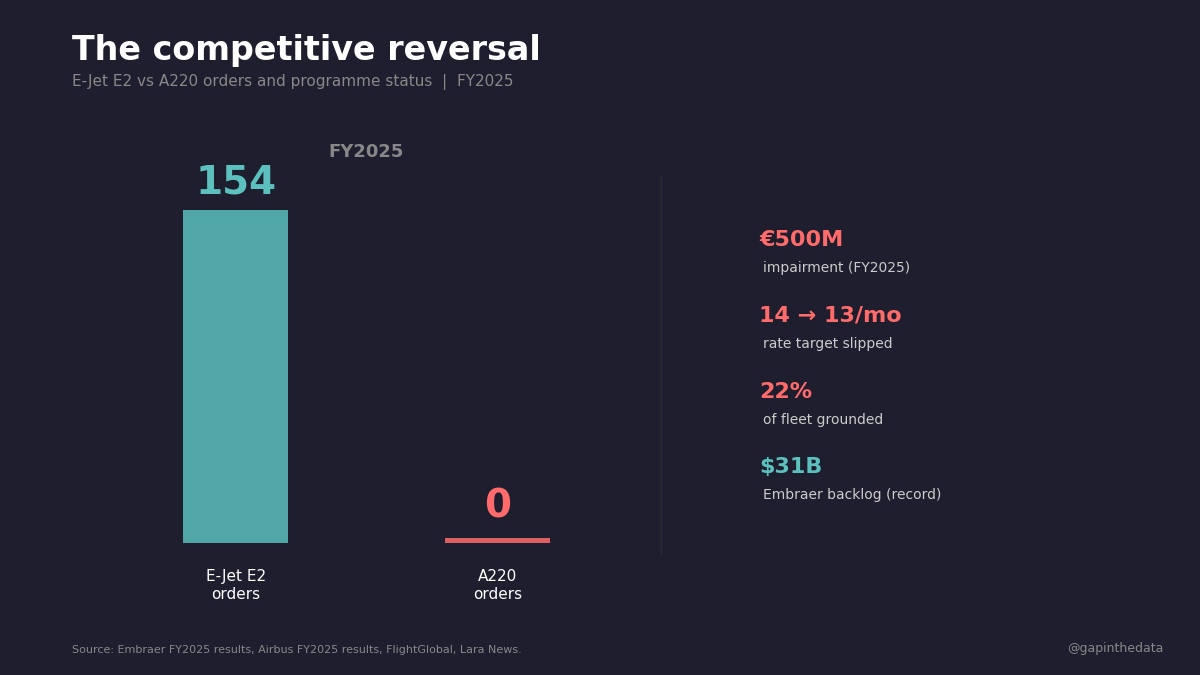
The E195-E2 is not a perfect substitute for the A220. It seats fewer passengers and its range is shorter. On a per-seat-mile basis the A220 is more efficient on longer sectors. But Airbus cannot deliver an A220 on a timeline that matters to an airline whose fleet is aging out, and evidently cannot price the A220 competitively on routes where the E2’s capacity is sufficient. The substitution is imperfect and it is happening anyway.
What the backlog costs
Airbus’s record backlog of 8,754 aircraft represents approximately eleven years of production at a rate of roughly 75 A320-family aircraft per month. It is the single most cited proof of the company’s competitive position. For airlines that can wait, it is exactly that.
For airlines that cannot wait, it is a barrier. Finnair’s A319s will not fly to 2032. The two-track solution (new Embraers for the routes the E2 can serve, used Airbuses for the routes it cannot) is itself a concession that no single manufacturer could meet Finnair’s needs on its timeline. The E195-E2 at 134 seats cannot replace an A320 on every route. The RFP for used A320/A321ceos exists because the gap between the E2’s capacity and the network’s requirements is real. Finnair is not choosing Embraer over Airbus. It is choosing the only options available before 2032.
That purchasing decision has now been made twice in the Nordics in nine months. Each time, the new-build order went to Embraer. Each time, Airbus’s contribution was limited to aircraft it built a generation ago, sold on the secondary market at prices it does not control.
The same 8,754 aircraft that support the bull case are the reason Finnair’s two billion euros went to São José dos Campos and the used-aircraft market instead of Toulouse. The backlog at 75 per month is eleven years of committed production. For a growing number of airlines, it is also a closed door.
Footnotes
1 Finnair press release, “Finnair places order for up to 46 Embraer E195-E2 aircraft,” March 23, 2026. 18 firm + 16 options + 12 purchase rights. PW1900G engines. 134-seat configuration. Deliveries Q3 2027 through 2030 (3/6/6/3). Total investment through 2029: ~€2B. Kuusisto: “one of the largest investments in Finnair’s 102-year-old history, and a vital step in our strategy.”
2 Finnair fleet renewal briefing and analyst call, March 23, 2026. RFP for up to 12 used A320/A321ceo aircraft. Current narrowbody fleet: A319s and A320s averaging 23+ years, oldest frames from 2000-2001. No A320neo or 737 MAX delivery slots available until 2032-2033. Rovelli quote on secondary market tracking.
3 Rovelli interview, March 2026. “The A220 has a longer range; it carries more people. But the question was, was that something that was best suited to our network or not?”
4 Embraer and Airbus list prices. E195-E2: ~$71M. A220-300: ~$93M. List prices are indicative; negotiated prices are lower, but the relative gap persists across industry estimates.
5 FlightGlobal, “Airbus Trims A220 Production Targets,” October 30, 2025. Rate 14 target reduced to 12 for 2026; partial recovery to 13 targeted by 2028. Faury: “a bit premature to be more specific on a date” regarding breakeven. See Three Loss-Making Ramps.
6 ch-aviation, “Québec Writes Off US$285M in A220 Programme,” October 2025. C$400M write-down of provincial investment.
7 Author’s analysis of Airbus and Embraer order data, FY2025. A220: zero new orders in 2025. See What 8,754 Aircraft Actually Means.
8 Lara News, “Airbus Pushes A220 Production Target Back,” November 2025. ~22% of global A220 fleet grounded due to PW GTF inspections; turnaround ~300 days.
9 SAS press release, July 2025. 45 firm + 10 option E195-E2s, valued at approximately $4 billion. See also Embraer Q3 2025 investor presentation.
10 Finnair / Norra pilot union agreement, 2025. Maximum jets increased from 12 to 18, accommodating incoming E2 fleet.
11 Embraer FY2025 results and Q4 2025 investor presentation. 154 E-Jet E2 orders in 2025. Record backlog: $31B. ~75 E2 deliveries in 2025, targeting ~80 in 2026 and 100 by 2027-2028.