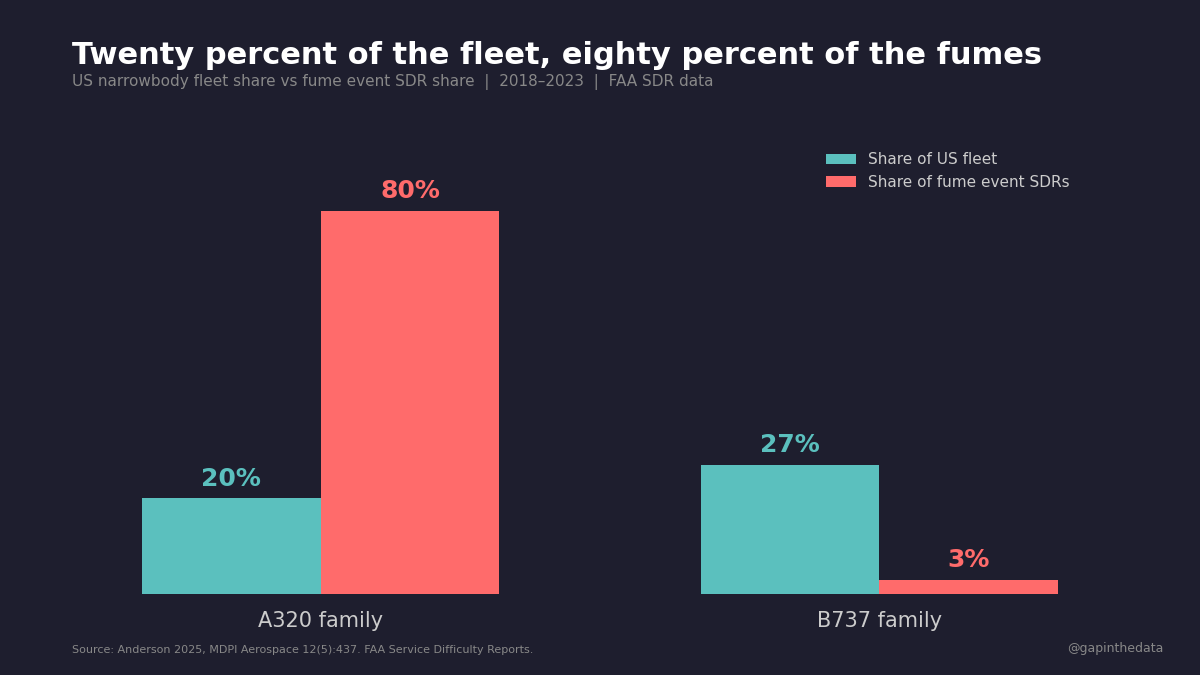
The A320 family is one-fifth of the American narrowbody fleet. It generates four-fifths of reported cabin fume events.
Between 2018 and 2023, the FAA’s Service Difficulty Reporting system recorded fume events across the US commercial fleet. The A320 family (A318 through A321) accounted for 20% of registered narrowbody aircraft and 80% of fume event reports. The Boeing 737 family accounted for 27% of the fleet and 3% of reports.1
The fleet-adjusted ratio is approximately 36 to 1. Reporting culture inflates it. Southwest, an all-737 operator, files SDRs only for confirmed mechanical defects; JetBlue, all-A320, documents aggressively through environmental standards committees.1 The true engineering-driven differential is lower than 36, but not by enough to matter.
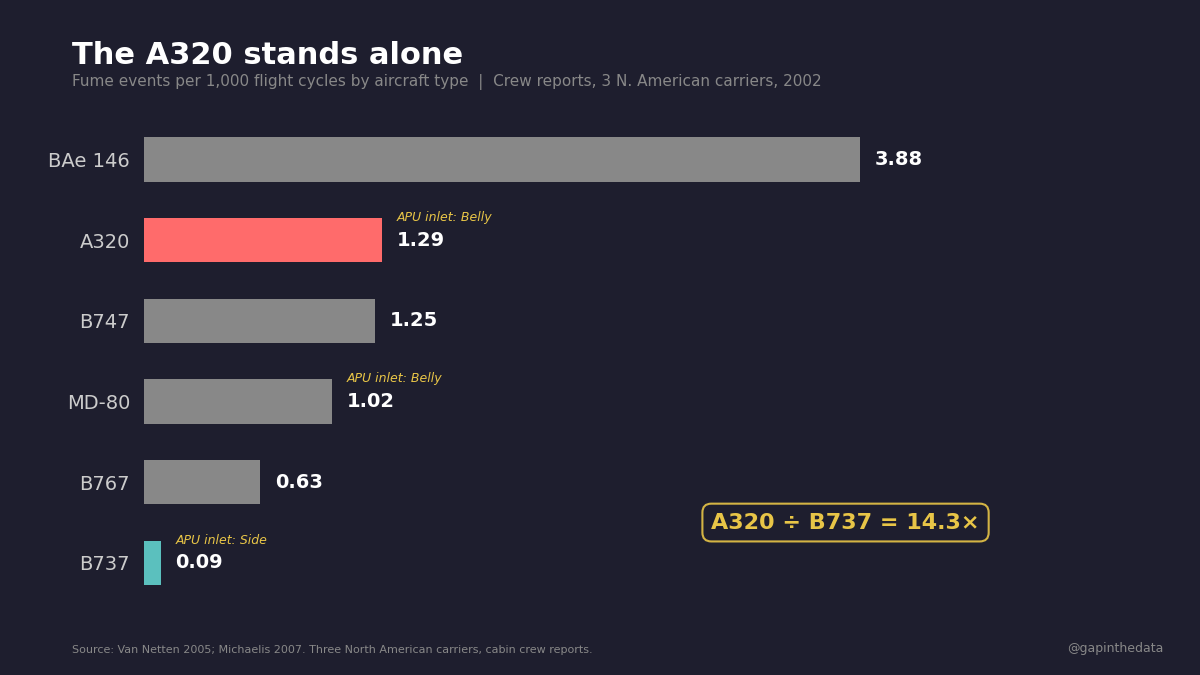
Three independent datasets agree on direction and magnitude. Within-airline comparisons at American, United, and Delta, all of which operate both types, show the A320 generating fume events at approximately seven times the 737 rate.2 An independent study of three North American carriers in 2002, using crew reports rather than SDRs, found the A320 at 1.29 events per 1,000 flight cycles versus the 737 at 0.09: a factor of 14.3, from a different methodology, in a different decade, by different researchers.3 The range across all three datasets is 7 to 36 times, depending on how you control for reporting. No dataset finds less than seven.
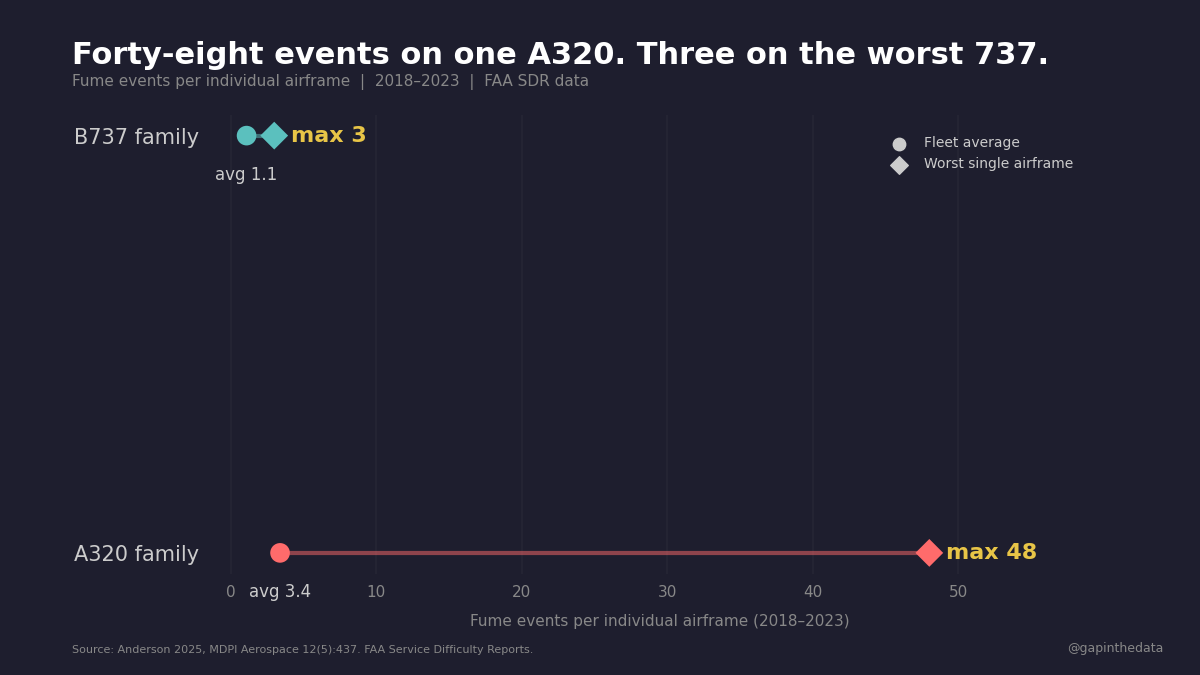
The per-airframe data eliminates the reporting argument entirely. Between 2018 and 2023, 143 individual A320 airframes recorded five or more fume events. The single worst A320 accumulated 48. The single worst 737 had three.1 Reporting culture cannot generate a 48-event tail on one airframe. That is the airplane.
British Airways recorded 536 fume events across its fleet in the first nine months of 2019, with more than 120 in October alone.4
I. The inlet
Every commercial jet except the Boeing 787 pressurises its cabin with bleed air, compressed air tapped from the engine compressor stages before combustion. No chemical filtration sits between the compressor and the cabin. When engine or APU oil seals degrade, or when contaminants enter the compressor inlet, lubricating oil pyrolyses at engine temperatures and circulates into the cockpit and cabin as a complex chemical mixture.5
The A320 and the 737NG use the same auxiliary power unit: the Honeywell 131-9. The fume event rates are not the same.
The difference is where the air enters. The 737’s APU inlet is mounted on the side of the aft fuselage, physically separated from primary drain and leak pathways. The A320’s is on the belly, close to drain masts, oil spillage paths, and ground-level contaminants.5
Airbus’s own internal programme, Project Fresh, reviewed A320 fume events from 2016 to 2021 and found that only 12% of APU fume events originated from internal seal leaks. The other 88% were external contaminants ingested through the belly inlet.6 The finding is Airbus’s. The problem is not ageing seals. It is where they put the hole.
Project Fresh also identified the fix: relocate the APU inlet to the top of the fuselage. Projected reduction in cabin odour events: 85%.6 The fix will be applied to new-build aircraft from 2026 onward. There is no retrofit programme for the approximately 10,000 A320-family aircraft currently in service worldwide. The aircraft that exist, the ones carrying passengers today, fly unchanged.
II. What enters the cabin
The chemicals of primary concern are organophosphates: tricresyl phosphate and its ortho-isomer, TOCP, an anti-wear additive in jet engine lubricating oil at 1 to 5% concentration. TOCP inhibits acetylcholinesterase, the enzyme targeted by sarin and VX, and can cause organophosphate-induced delayed neuropathy. Contaminated bleed air also delivers carbon monoxide, aldehydes, and ultrafine particles peaking at 96,700 per cubic centimetre on A320s, among more than a hundred volatile organic compounds.7
The biomarker evidence for crew exposure is stronger than industry assessments acknowledge.
In 2011, a Germania 737 co-pilot had blood drawn immediately after a fume event. The University of Nebraska BChE adduct assay found the sample positive for TOCP, with 1.4% of butyrylcholinesterase modified.8 This is the gold-standard case: immediate blood draw, validated assay, unambiguous result. Separately that year, Liyasova and colleagues tested twelve routine passengers on ordinary commercial flights, not fume events, and found half positive for TOCP adducts.8
In 2025, Furlong and colleagues at the University of Washington and University of Nebraska compared 81 fume-exposed subjects with 25 controls. BChE adduct levels were 7.4 times higher in the exposed group.9
A German study of 332 crew members found no detectable TOCP metabolites in urine after fume events.10 It did find significantly elevated levels of tributyl phosphate and triphenyl phosphate metabolites, compounds whose human chronic toxicology the researchers described as “completely missing.” TPP crosses the blood-brain barrier and causes neuroinflammation in animal studies. TBP’s chronic effects are similarly uncharacterised.10
These findings are not contradictory. They expose a detection problem that is structural rather than accidental. Organophosphate metabolites clear urine in 24 to 48 hours. No airline protocol requires immediate blood draws after fume events. The one case with an immediate draw was positive. The 332-sample German study did not specify collection timing; if samples were taken more than 48 hours after exposure, the assay is blind to TCP.8 The system generates negative results by measuring too late, then cites the negative results as evidence of safety.
III. What happens to crews
Cologne, December 2010. Germanwings A319 D-AGWK, on approach at 3,000 feet. Both pilots experienced severe dizziness, contracted vision, and tingling. The first officer was classified as partially incapacitated. The captain assessed that a go-around was impossible and landed in conditions he described as “surreal, as within a dream.” Airbus’s own aviation medicine adviser called it “very serious” and stated that the pilots “were almost unable to act,” calling it an “incapacitation” of “greatest concern in terms of flight safety."11 The first officer required six months of recovery. The BFU did not open an investigation until nearly a year later, prompted by a journalist raising the incident at a Bundestag committee hearing. The same airframe had recorded a fume event in Dublin two years earlier.
Heathrow, September 2019. British Airways A320 G-EUYB, arriving from Zurich. Both pilots donned oxygen masks on approach. After landing, the first officer was fully incapacitated, vomiting from the cockpit window. Both were hospitalised. The AAIB could not identify the contaminant or source. The aircraft returned to service.12 This was one of 536 fume events BA recorded that year.
Las Vegas, February 2019. Spirit Airlines A319 N531NK diverted after cockpit smoke. Three flight attendants were hospitalised. One suffered a cerebral haemorrhage resulting in hemiplegia and nerve damage. Laboratory results showed critically low cholinesterase enzyme levels, a specific biomarker of organophosphate exposure.13
Portland, January 2017. Captain Andrew Myers of JetBlue collapsed during an A320 maintenance engine run. He was diagnosed with toxic encephalopathy and neurocognitive disorder. In 2020, the Oregon Workers’ Compensation Board ruled that his brain damage was causally linked to fume exposure, the first such legal finding in the United States. The administrative law judge noted that JetBlue was “more concerned about keeping planes in the air than worker safety” and imposed a 25% penalty for bad-faith denial of the claim.14 Myers’s career is over.
Boston, July 2015. Captain James Anderberg of Spirit Airlines and his first officer were both incapacitated during descent in an A319. Neither pilot recalled the landing.15 The first officer, who received ALPA’s Presidential Citation for the recovery, cited employer intimidation as the reason for not filing the mandatory safety report. The FAA and NTSB were unaware of the event for years.
Anderberg developed progressive neurological deterioration over the following fifty days: hand tremors, confusion, loss of coordination. His autopsy showed acute myocardial infarction and cardiac interstitial and perivascular fibrosis, a pattern consistent with organophosphate cardiac pathology. Necropsy literature from fatal OP poisoning shows myocardial interstitial oedema in 13 of 13 cases and patchy interstitial inflammation in 8 of 13.15 The medical examiner ruled the cause of death undetermined, stating that “it is also possible that recent exposure to organophosphates caused or contributed to death.”
The FAA learned about the event years after it occurred.
IV. What Airbus did
When A320neo deliveries began in 2016 and fume event rates climbed, Airbus did not accelerate the fix. It loosened the maintenance rules. Under airline pressure, Airbus reclassified fume events as “minor comfort issues” and eliminated the requirement for inspection and deep cleaning after every event, aware this would increase incident rates.16 Since Airbus’s Aircraft Maintenance Manual is the de facto regulatory standard, with no regulatory floor below it, airlines followed the new, lower threshold.
Project Fresh identified the 85% solution. It is being applied only to aircraft that have not yet been built.6
Airbus has declined interview requests from the Wall Street Journal, CBS, and ABC News on this subject.16
Airlines are absorbing the cost of the design defect. Delta is replacing auxiliary power units on all 321 of its A320-family aircraft at an estimated cost of $75 million to more than $360 million, the largest voluntary remediation effort in the fume-event space and a fleet-wide expenditure to fix what Airbus designed.17 EasyJet installed carbon and HEPA filters across its A320 fleet in 2017, citing operational cost (“cabin odour events can lead to expensive delays”), not crew health.17 American Airlines has been upgrading APU seals since April 2023. The same year, OSHA found American retaliating against flight attendants who reported fume-related illness, docking attendance points for filing exposure complaints.17
The companies fixing the problem are the ones that concluded Airbus’s answer was inadequate.
V. What regulators didn’t do
In 2007, the UK Air Accidents Investigation Branch recommended that EASA and the FAA require contaminated air warning systems on all large commercial aircraft. Nineteen years later, no such system has been mandated.18 If sensors were installed, fume events would be detectable, quantifiable, and attributable, making reclassification as comfort issues impossible.
In 2012, EASA terminated its own rulemaking task on cabin air quality without amending the certification specification. No contamination limits. No monitoring mandates. No bleed-free requirements.19 The stated justification was insufficient scientific consensus. The FACTS project, funded by a consortium including Airbus and Honeywell, was supposed to build that consensus; it measured only background conditions across 69 monitored flights, capturing zero actual fume events.19 When you design research to not find the problem, you can cite the research as evidence that the problem does not exist.
In 2013, the FAA reported 69 fume events to Congress. The same database contained 1,353.19 A twenty-fold undercount delivered to the legislature charged with oversight.
Congress has attempted to address cabin air quality at least nineteen times over two decades. Industry lobbying defeated every attempt.20 In 2003, Congress directed the FAA to create a fume event tracking system. No such system exists.
In Germany, the BFU documented 663 fume events in its records. Not a single one from BFU investigations had been reported to EASA’s ECCAIRS occurrence database.20 The mandatory reporting system for fume events did not function.
Unlike the FAA’s SDR database, which can be freely downloaded and analysed, EASA occurrence data is not publicly accessible. The Anderson study and the Wall Street Journal investigation that exposed the scale of the A320 fume problem both relied entirely on American data. European-operated A320 fume events are invisible to independent analysis.20
EASA is funded 72 to 74% by fees charged to the industry it regulates. Airbus is the single largest payer.20
The declarations said none. The maintenance rules said minor comfort issue. The reporting system said nothing to see.
The same institutional machinery. The same relationship between manufacturer, regulator, and rules. The same outcome: the people who designed the system are protected, and the people who breathe the air are not.
Airbus identified the defect. Airbus quantified the defect. Airbus identified the fix. The fix will be applied to aircraft Airbus has not yet sold. The ten thousand aircraft already in service, carrying crews and passengers now, will fly with the belly inlet until they are retired.
The word for this is not negligence. Negligence implies they didn’t know.
Footnotes
1 Anderson 2025, “Aircraft Type as a Risk Factor for Cabin Air Supply Contamination Events,” MDPI Aerospace 12(5):437. A320 family: 80% of fume event SDRs, 20% of US fleet. B737 family: 3% of fume event SDRs, 27% of fleet. Per-airframe: A320 average 3.4 events (max 48), B737 average 1.1 (max 3). 143 individual A320 airframes recorded 5+ events in four years. Author affiliated with AFA-CWA (disclosed). Data publicly verifiable from FAA SDR downloads.
2 WSJ investigation, September 2025. Within-airline analysis at American, United, and Delta using more than one million maintenance records. A320 fume event rate approximately 7x B737 rate at the same carriers. Independent analysis, different methodology from Anderson, consistent direction and large magnitude.
3 Van Netten 2005; Michaelis 2007. Cabin crew reports from three North American carriers, 2002 data. A320: 1.29 per 1,000 cycles. B737: 0.09 per 1,000 cycles. 14.3x differential. Completely independent of Anderson and WSJ datasets. Cross-type comparison also in Michaelis et al. (2021), “Ultrafine Particle Levels Measured on Board Short-Haul Commercial Passenger Jet Aircraft,” Atmosphere 12(8):1020.
4 Paddleyourownkanoo.com, “British Airways reported over 530 smoke, fume or smell events on its aircraft in just 12 months,” July 2020. 536 events in the first nine months of 2019. October 2019 alone: over 120 events.
5 Bleed air system: all commercial jets except B787 use engine bleed for cabin pressurisation. No chemical filtration in bleed path (HEPA filters address biological contamination only). A320 APU inlet on belly: Airbus FAST #52, August 2013, which candidly acknowledged “a noticeable cabin odor can be generated from ingesting only a very small amount of oil” from APU. B737 APU inlet on side of aft fuselage. Both use Honeywell 131-9 APU.
6 Airbus Project Fresh, internal programme reviewing A320 fume events 2016-2021. 88% of APU fume events from external ingestion through belly inlet; 12% from internal seal leaks. Inlet relocation to top of fuselage: projected 85% reduction. New-build only from 2026. No retrofit for existing fleet. Reported in WSJ, September 2025.
7 TCP/TOCP: 1-5% concentration in jet engine lubricating oils (Mobil Jet Oil II, Eastman Turbo Oil 2197, etc.). Ortho-cresyl phosphate (TOCP) inhibits acetylcholinesterase via the same mechanism as organophosphorus nerve agents. Ultrafine particles: peak 96,700/cm^3 on A319/A320 during APU operation, Michaelis et al. (2021). 100-300+ volatile organic compounds identified in contaminated cabin air samples across multiple studies. Carbon monoxide confirmed in multiple incidents including Spirit Airlines Denver (2018).
8 Germania 737 co-pilot (2011): blood drawn immediately post-event, University of Nebraska BChE adduct assay positive for TOCP, 1.4% BChE modification. Liyasova et al. (2011), Toxicology and Applied Pharmacology, peer-reviewed: 12 routine passengers tested 24-48 hours post-flight, 50% positive for TOCP adducts on normal flights. OP metabolites clear urine in 24-48 hours; no airline or regulatory protocol requires immediate blood draws after fume events.
9 Furlong et al. (2025), University of Washington and University of Nebraska, medRxiv preprint. 81 fume-exposed subjects vs 25 controls. BChE adduct levels 7.4x higher in exposed crew.
10 Schindler et al. (2013), “Occupational exposure of air crews to tricresyl phosphate isomers and organophosphate flame retardants after fume events,” Archives of Toxicology. 332 crew urine samples: no detectable o-TCP, but TBP and TPP metabolites significantly elevated vs general population. TPP crosses blood-brain barrier, causes neuroinflammation in animal models (Li et al. 2020). Researchers described human chronic toxicology data for TBP and TPP as “completely missing.”
11 BFU investigation, Germanwings A319 D-AGWK, Cologne, December 19, 2010. Captain: “severe tingling, contracted vision, strong dizziness.” FO: “partially incapacitated.” Go-around assessed impossible. Landing: “surreal, as within a dream.” FO: six months recovery. Airbus aviation medicine adviser Dr Andreas Bezold: “very serious… the pilots were almost unable to act… this ‘incapacitation’ is of greatest concern in terms of flight safety.” Same airframe: prior fume event May 2008, Dublin. Investigation not opened until ~1 year later, prompted by journalist at Bundestag committee.
12 AAIB Serious Incident Report, Airbus A320-232 G-EUYB, September 23, 2019. Both pilots on oxygen during approach. FO incapacitated post-landing, vomiting from cockpit window. Both hospitalised. No definitive cause identified. Aircraft returned to service.
13 Spirit Airlines A319 N531NK, February 27, 2019. Diverted to Las Vegas after cockpit smoke. Three FAs hospitalised. One: cerebral haemorrhage, hemiplegia, nerve damage. Lab results: critically low cholinesterase. Part of a Spirit cluster (2015-2019): captain death, FA stroke, CO poisoning confirmed (Denver 2018), 8 passengers hospitalised (Las Vegas, July 2019), FAA/NTSB unaware of most events.
14 Oregon Workers’ Compensation Board ruling, 2020. Captain Andrew Myers, JetBlue, January 2017. Collapsed during A320 maintenance engine run. Diagnosed: toxic encephalopathy, neurocognitive disorder. ALJ: causal link established, the first US legal recognition. “More concerned about keeping planes in the air than worker safety.” 25% penalty for bad-faith denial.
15 Captain James Anderberg, Spirit Airlines A319, July 17, 2015, descent into Boston. Both pilots incapacitated; neither recalled landing. FO account via ALPA (FO Tellman, Presidential Citation). FO cited employer intimidation for not filing mandatory report. FAA/NTSB unaware for years. Anderberg: progressive neurological deterioration over 50 days: hand tremors, confusion, coordination loss. Autopsy: acute myocardial infarction + cardiac interstitial and perivascular fibrosis. ME: “undetermined”; “also possible that recent exposure to organophosphates caused or contributed to death.” OP cardiac pathology: necropsy literature shows 13/13 cases with myocardial interstitial oedema, 8/13 patchy inflammation; animal studies confirm OP-induced myocardial fibrosis.
16 WSJ investigation, September 2025; internal Airbus documents reviewed. Airbus reclassified fume events as “minor comfort issues,” eliminated post-event inspection and deep cleaning requirement, under airline pressure, while aware incident rates would increase. Airbus AMM/TSM is de facto regulatory standard, with no regulatory floor below it. Declined all interview requests (WSJ, CBS, ABC). JetBlue separately reclassified fume events as “odour events” to avoid FAA reporting thresholds (Garamendi/Blumenthal Congressional letter, September 2019).
17 Delta: replacing APUs on all 321 A320-family aircraft, ~90% complete by late 2025, estimated $75M-$360M+. Source: Simple Flying. EasyJet: Pall Aerospace PUREair filters on entire A320 fleet (2017); motivation: “aircraft cabin odour events can lead to expensive delays.” American Airlines: APU seal upgrades since April 2023. OSHA (January 2023): AA retaliated against FAs reporting fume illness, docked attendance points. Repeat offence.
18 AAIB Safety Recommendations 2007-002 and 2007-003, directed to EASA and FAA: require contaminated air warning systems on all large commercial aircraft. Unimplemented as of 2026. Boeing separately refused to install air quality sensors citing “fear of litigation” from crew who would be sickened by events the sensors would detect (Williams v. Boeing discovery, 2011).
19 EASA terminated rulemaking task 25.035 in 2012 (ED Decision 2012/001/R) without amending CS-25. FACTS project: consortium included Airbus and Honeywell; 69-flight precursor study captured zero fume events; OELs used were ground-based, “not developed for application at altitude or for complex heated mixtures.” FAA 2013 report to Congress: 69 fume events cited; same database contained 1,353.
20 Congress: at least 19 legislative attempts over two decades, defeated by industry lobbying. 2003 directive to FAA for fume event tracking system: no system exists as of 2026. BFU (Germany): 663 documented fume events; zero from BFU investigations reported to EASA’s ECCAIRS database. EASA occurrence data not publicly accessible (unlike FAA SDRs). EASA funding: 72-74% from industry fees (EASA Annual Accounts 2020-2022, European Parliament filings); Airbus is the largest single fee-payer.