How a single engine dispute can vaporize a $7–8 billion order.
On February 13, 2026, United Airlines disclosed in its annual SEC filing that it has effectively removed the Airbus A350-900 from its fleet plans.1
These forty-five aircraft, first ordered in 2009, converted from A350-900 to A350-1000 in 2013, converted back to A350-900 in 2017, deferred from 2022 to 2027, and then pushed past 2027, are now shown with no expected delivery date at all.1
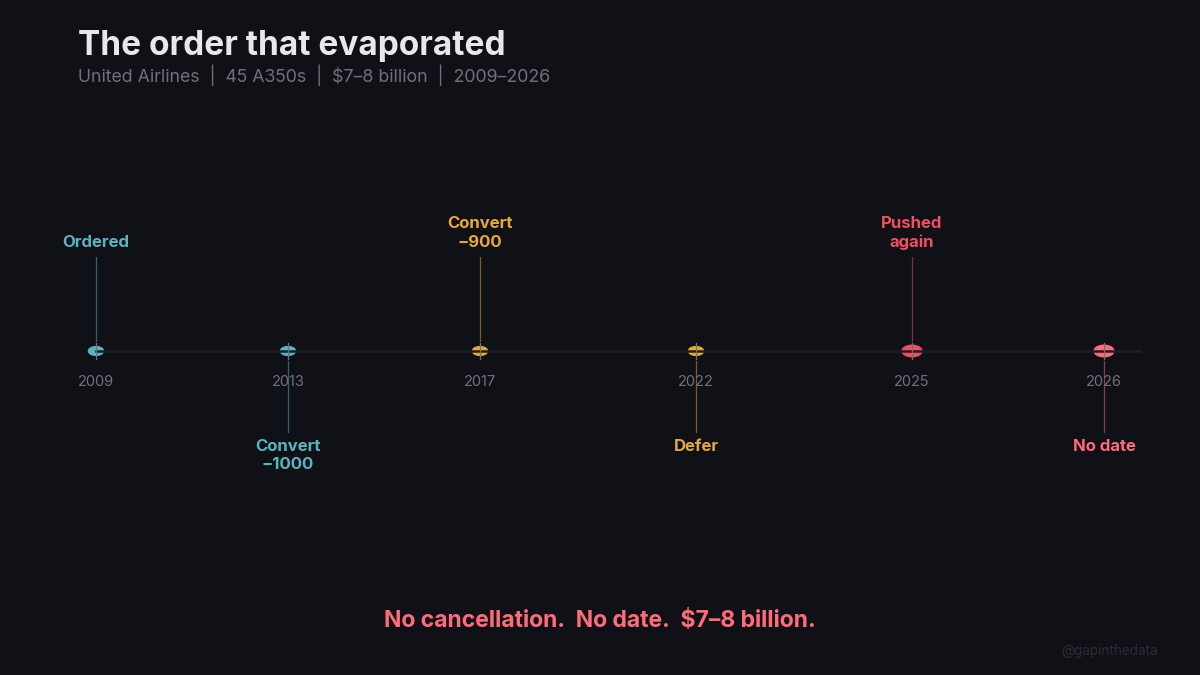
The trigger was a legal dispute with Rolls-Royce. United paid the engine maker $175 million in 2017 under a commitment agreement signed in 2010. In December 2025, United alleged Rolls-Royce breached the agreement and demanded repayment with contractual escalation. Rolls-Royce refused, terminated the agreements, and countered that United was in breach.1
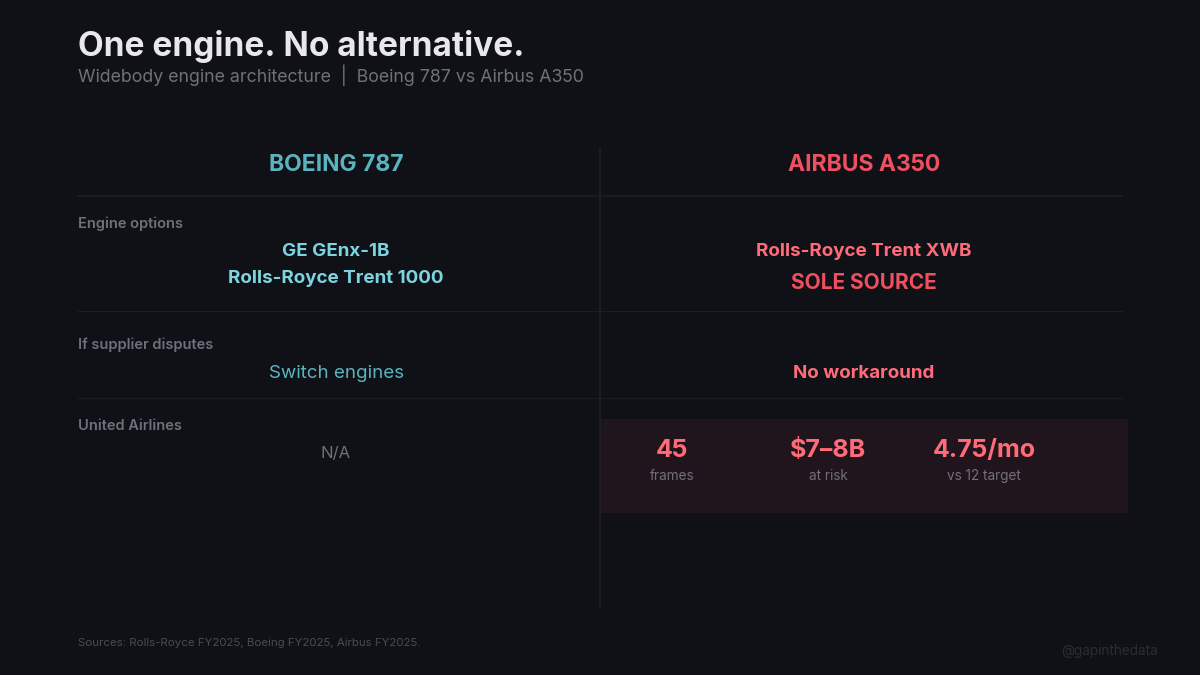
The A350 is powered exclusively by the Rolls-Royce Trent XWB, for which there is no alternative engine.2
United’s SEC filing now shows 45 A350s as contractual commitments sitting “after 2027,” but with zero planned deliveries in any year.2 The order has not been formally cancelled, yet a major US carrier has disclosed to the SEC that it plans no deliveries at all under current arrangements.
At the net prices airlines typically pay, which industry estimates place at 50 to 55 percent below widebody list prices, the order is worth an estimated $7 to $8 billion.6
For Airbus, the timing is acute. The A350 programme delivered 57 aircraft in FY2025, an average of 4.75 per month against a long-term target of twelve, while contending with five airworthiness directives in eight months.3 The path to rate 12 depends on spreading fixed costs across a growing number of airframes. Forty-five fewer aircraft in the delivery pipeline compresses the timeline over which the programme can amortise those costs, at a moment when the A350 is one of three loss-making ramps diluting group margins.
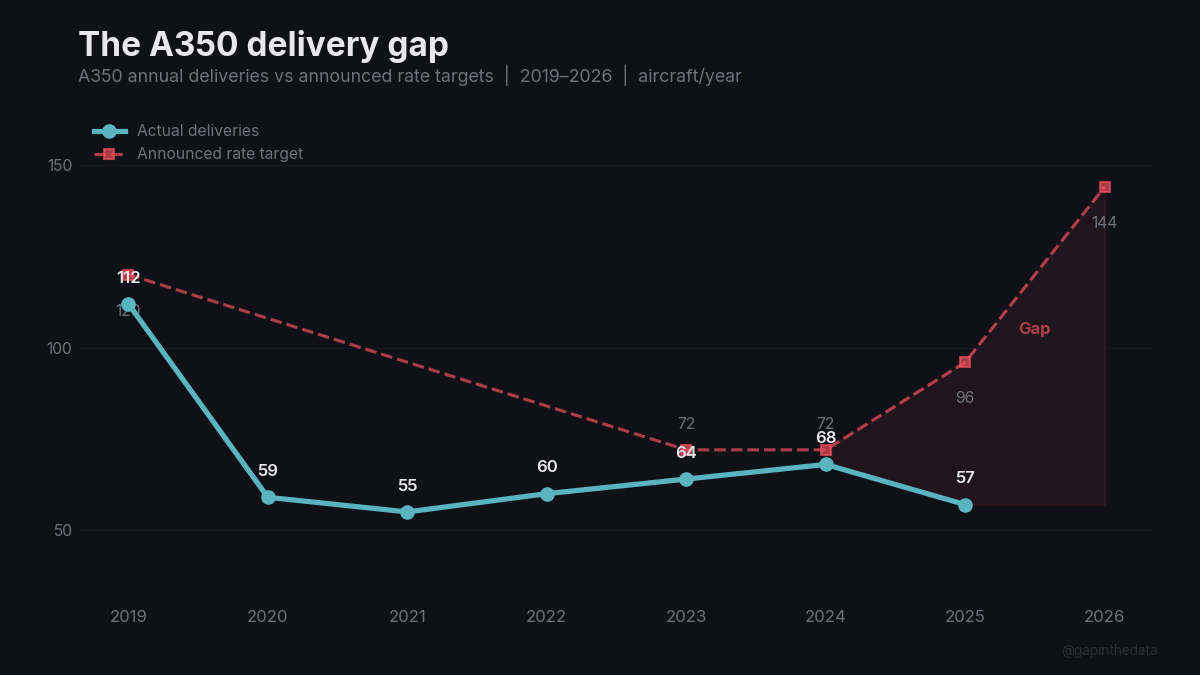
The A350 has 1,529 firm orders from 66 customers.4 Losing 45 threatens the ramp rather than the backlog: the sequence and timing of deliveries that determines when per-unit costs begin to fall depends, at a production rate still struggling to reach six per month, on every slot, in a programme whose sole-source composite structures are manufactured in China by the competitor’s founding shareholder. Whether Airbus can reallocate these slots to other customers, and how quickly, is a separate question with its own lead times, particularly when other carriers are themselves trimming A350F commitments.5
The deeper problem is architectural. The A350 is a single-engine-source aircraft. When the sole engine maker enters a legal dispute with the sole major US customer, there is no workaround, because there is no alternative engine and no substitute supplier, and the commercial relationship between airline and engine OEM becomes a hard constraint on the airframer’s production economics. The engine duopoly constraining the A320neo illustrates the same structural fragility from a different angle.
Boeing learned this lesson from the other direction: the 737 MAX’s CFM LEAP-1B is also sole-sourced, and when the MAX was grounded, CFM had no alternative customer for those engines.
United’s 45 A350s sit in a category that has no clean accounting treatment: contractually committed, commercially dead, and industrially consequential. They have not been cancelled, because cancellation would trigger penalty negotiations, and they have not been deferred, because deferral implies a future date. They simply have no date at all.
In the language of the SEC filing: after 2027, with nothing planned.
Footnotes
1 AirInsight, “United’s A350 Order in Peril Amid Rolls-Royce Legal Battle,” February 13, 2026. United paid $175 million in 2017; December 2025 breach allegation; Rolls-Royce termination and counter-assertion; no planned deliveries in 2026, 2027, or after 2027.
2 Simple Flying, “United Airlines Removes Airbus A350 From Its Fleet Plans Amid Rolls-Royce Dispute,” February 13, 2026. 45 A350s still listed as firm commitments contractually “after 2027” but zero expected deliveries shown. A350 is exclusively Rolls-Royce Trent XWB-powered.
3 Airbus, “Airbus Reports Full-Year (FY) 2025 Results,” February 19, 2026. 793 deliveries (57 A350s); 2026 guidance: ~870 deliveries. A350 rate 12 target for 2028.
4 Wikipedia, “List of Airbus A350 Orders and Deliveries,” accessed February 2026. 1,529 firm orders from 66 customers.
5 Air France-KLM cut its A350F order by 25% in its FY2025 results (coverage).
6 Industry discount estimates from Leeham News, Ascend by Cirium. Widebody discounts of 50–55% from list prices are standard for large orders. Valuation based on approximately 45 aircraft at estimated net prices.